
Understanding 304 Stainless Steel Mesh Screen for Industrial Applications

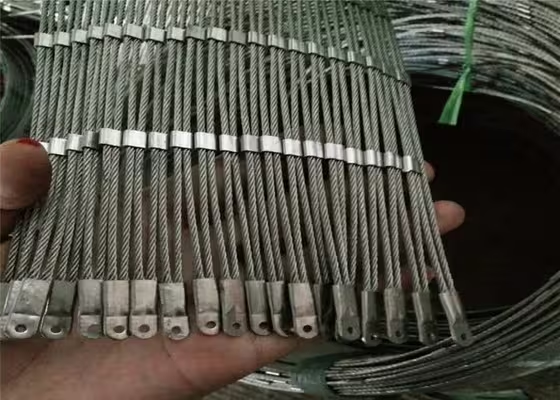
In the demanding world of industrial and commercial construction, reliable cable management is not an option—it’s a prerequisite for safety, efficiency, and longevity. Our cable tray wire mesh stands as the premier solution for organizing and supporting power, data, and communication cables across a vast array of applications. Engineered from high-quality steel wire and fabricated through precision welding, this open-design tray system offers unparalleled strength, ventilation, and flexibility. Unlike solid-bottom trays, a wire mesh cable tray allows for optimal heat dissipation, easy cable access at any point, and superior visibility for maintenance and inspection teams. It is the intelligent choice for projects where adaptability, durability, and compliance with international standards are paramount.
Our cable tray wire mesh is designed with the professional installer and end-user in mind, incorporating features that streamline installation and ensure decades of reliable service.
Our wire mesh cable tray is manufactured to exacting standards, including NEMA VE1, BS EN 61537, and other international benchmarks. The table below outlines our core product range specifications.
| Parameter | Standard Specification | Heavy-Duty Option | Stainless Steel Option |
|---|---|---|---|
| Material | Mild Steel, Pre-galvanized | Mild Steel | AISI 304 / 316 Stainless Steel |
| Wire Diameter | 4.0 mm / 5.0 mm | 5.0 mm / 6.0 mm | 4.0 mm / 5.0 mm |
| Mesh Opening | 50 x 100 mm (Standard) | 50 x 100 mm | 50 x 100 mm or 25 x 50 mm |
| Standard Width (W) | 50mm, 100mm, 150mm, 200mm, 300mm, 450mm, 600mm | 100mm, 150mm, 200mm, 300mm, 450mm, 600mm | 50mm, 100mm, 150mm, 200mm, 300mm |
| Standard Side Height (H) | 50 mm, 75 mm, 100 mm | 75 mm, 100 mm, 150 mm | 50 mm, 75 mm, 100 mm |
| Standard Length | 2.0 meters, 2.5 meters, 3.0 meters | 2.0 meters, 3.0 meters | 2.0 meters, 3.0 meters |
| Surface Treatment | Hot-Dip Galvanized (≥80µm) | Hot-Dip Galvanized (≥85µm) | Passivated / Mill Finish |
| Load Class (BS EN 61537) | Class C (Moderate Load) | Class B (Heavy Load) | Class C / B (Depending on spec) |
Note: Custom sizes, widths, heights, and finishes are available upon request to meet specific project requirements.
The versatility of cable tray wire mesh makes it the system of choice for engineers and contractors across countless industries. Its primary advantage lies in scenarios where cables require frequent changes, high visibility, or exceptional cooling.
Choosing the right cable support system has long-term implications for cost, safety, and operational flexibility. Our cable tray wire mesh provides distinct benefits compared to ladder tray, solid-bottom tray, or conduit systems.
As a specialist manufacturer and global supplier, we offer more than just a product; we provide a certified, reliable, and fully supported cable management solution.
A: While both are open-design trays, a cable tray wire mesh features a grid of welded wires forming a continuous mesh surface. A ladder tray has two side rails connected by individual, evenly spaced rungs. Mesh trays generally offer better cable retention for smaller cables and a more uniform appearance, while ladder trays can have a slightly higher load capacity for very heavy, large-diameter cables over extremely long spans.
A: Sizing depends on the number, diameter, and weight of cables, as well as the fill ratio and support spacing. We strongly recommend consulting the relevant engineering standards (like IEC 61537) and utilizing our technical support. Provide us with your cable schedule and layout, and our engineers can recommend the optimal wire mesh cable tray width, height, and support interval.
A: Yes, absolutely. When specified with a hot-dip galvanized finish (with a sufficient zinc coating thickness, e.g., >80µm) or in stainless steel (AISI 316 for severe coastal/industrial atmospheres), our cable tray wire mesh is highly resistant to corrosion and perfectly suited for outdoor installations, including rooftops, walkways, and industrial yards.
A: This is governed by local electrical codes (e.g., NEC, IEC). Generally, power and control cables can share a tray, but specific separation rules often apply between high-voltage and low-voltage/data cables, sometimes requiring partitions within the tray. Always design the installation in compliance with the authority having jurisdiction (AHJ) in your project location.
A: For standard sizes and finishes, our lead time is typically 2-4 weeks after order confirmation. We specialize in custom manufacturing and can produce cable tray wire mesh in non-standard widths, heights, lengths, and wire diameters to meet unique project specifications. Contact us with your detailed requirements for a custom quote and production timeline.
Understanding 304 Stainless Steel Mesh Screen for Industrial Applications

Detailed Analysis of 24 mesh stainless steel screen Applications and Performance

Comprehensive Guide to Durable 316 Stainless Steel Security Screens
Understanding 12 mesh stainless steel screen Applications and Technical Details

Understanding 30 Mesh Stainless Steel Screen Applications and Material Properties
Ready to move your project from technical blueprint to precision reality? Whether you require large-scale CNC machining, complex structural assembly, or specialized fabrication with rare alloys like Titanium and Nickel, our engineering team is prepared to assist. At metalfabricationcn.com, we solve the manufacturing challenges that others find too large or too complex. Reach out today to discuss your specific requirements, and let us help you optimize your supply chain with ISO 9001 certified reliability.