
Understanding 30 Mesh Stainless Steel Screen Applications and Material Properties

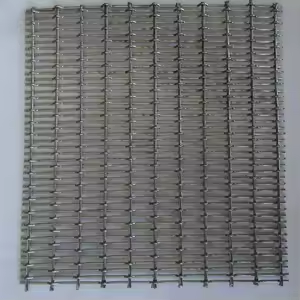
In the demanding world of industrial manufacturing and construction, precision-engineered materials form the backbone of reliability and efficiency. Among these, mesh woven wire stands out as a versatile and indispensable component. Our high-performance mesh woven wire is manufactured to exacting international standards, offering unparalleled durability, precise aperture control, and exceptional strength-to-weight ratios. Engineered for a vast spectrum of industrial applications, from critical filtration systems to robust architectural facades, this product represents the synergy of advanced weaving technology and superior metallurgy. For global buyers seeking a dependable, high-quality supply of industrial wire mesh, this product page details the specifications, benefits, and applications that make our mesh woven wire the optimal choice for your projects.
Mesh woven wire is a grid-like material constructed from metallic wires interlocked in a precise, consistent weave pattern. This manufacturing process creates a sheet with uniform square, rectangular, or other geometric openings, known as the mesh aperture. The fundamental characteristics of mesh woven wire—including wire diameter, mesh count (openings per linear inch), and weave type—can be meticulously controlled to meet specific functional requirements such as particle retention, flow rate, structural integrity, or visual screening. Our product line encompasses a comprehensive range of materials, including stainless steel (304, 316, 316L), galvanized steel, aluminum, copper, and brass, each selected for its unique properties like corrosion resistance, conductivity, or tensile strength. This adaptability makes mesh woven wire a cornerstone material across sectors from mining and chemical processing to food & beverage and aerospace.
The following table outlines the standard specifications for our most commonly requested mesh woven wire products. Custom configurations outside these ranges are available upon request.
| Parameter | Specification Range / Details | Notes |
|---|---|---|
| Primary Materials | Stainless Steel 304/316/316L, Galvanized Low-Carbon Steel, Aluminum, Copper, Brass | Other alloys available for specialized requirements. |
| Weave Types | Plain Weave, Twill Weave, Dutch Weave, Reverse Dutch Weave | Plain weave is standard; Dutch weaves offer finer filtration. |
| Mesh Count (per inch/cm) | 2 to 635 Mesh (approx. 0.8 to 250 per cm) | Defines the number of openings. Lower count = larger openings. |
| Wire Diameter | 0.025 mm to 3.0 mm (0.001" to 0.125") | Thicker wire increases strength and durability. |
| Aperture Size (Opening) | 0.02 mm to 12.7 mm (0.0008" to 0.5") | The clear space between wires. Critical for sizing applications. |
| Sheet/Roll Dimensions | Width: up to 2.2 meters (86.6"). Roll Length: Custom up to 30 meters. | Pre-cut panels or continuous rolls available. |
| Surface Treatment | Mill Finish, Electropolished, PVC Coating, Nickel Plating | Enhances corrosion resistance, cleanliness, or appearance. |
The functional versatility of mesh woven wire makes it a critical component in countless industries. Its primary roles involve separation, filtration, shielding, reinforcement, and decoration.
Choosing the right mesh woven wire provides distinct operational and economic benefits compared to perforated plates, expanded metal, or polymer screens.
In a global market, partnership with a reliable and expert manufacturer is paramount. We distinguish ourselves through an unwavering commitment to quality, service, and technical expertise.
A: The key parameters are Material, Mesh Count, Wire Diameter, and Weave Type. Start by defining the environment (corrosive, high-temp?), the size of particles you need to retain or pass, and the required strength. Our technical team is always available to assist with this specification process.
A: Mesh count refers to the number of openings per linear inch. Aperture size is the actual measurement of the open space between the wires. A higher mesh count generally means a smaller aperture, but the wire diameter also affects the final opening size. Both specifications are critical when selecting mesh woven wire.
A: Absolutely. Our mesh woven wire can be precision-cut to shape, welded to frames, or formed into cylinders, cones, and other complex geometries. We offer value-added fabrication services to deliver ready-to-install components, saving you time and production costs.
A: Lead times vary based on material, specification, and quantity. Standard items are typically available from stock or within 1-2 weeks. For large custom orders, we provide firm production schedules upon quotation. We prioritize clear communication on timelines to ensure seamless integration with your project planning.
A: Consistency is achieved through automated, computer-monitored weaving machinery and a rigorous in-process quality control regimen. We perform frequent sample inspections to verify mesh count, wire diameter, and weave integrity throughout a production run, guaranteeing that every square meter of mesh woven wire meets the same high standard.
PREV:wire mesh crab net
NEXT:welding wire mesh
Understanding 30 Mesh Stainless Steel Screen Applications and Material Properties

Understanding 12 mesh stainless steel screen Applications and Technical Details
Strategic Custom Metal Fabrication Services

Detailed Analysis of 24 mesh stainless steel screen Applications and Performance
Understanding 20 mesh stainless steel screen Applications and Performance
Ready to move your project from technical blueprint to precision reality? Whether you require large-scale CNC machining, complex structural assembly, or specialized fabrication with rare alloys like Titanium and Nickel, our engineering team is prepared to assist. At metalfabricationcn.com, we solve the manufacturing challenges that others find too large or too complex. Reach out today to discuss your specific requirements, and let us help you optimize your supply chain with ISO 9001 certified reliability.