
Comprehensive Guide to Durable 316 Stainless Steel Security Screens

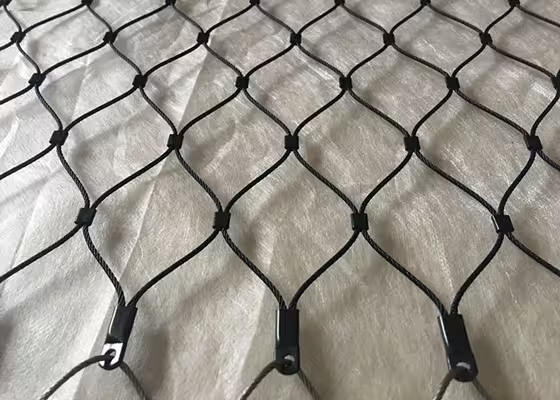
In the demanding world of industrial applications, finding a material that combines exceptional strength with remarkable flexibility can be a challenge. Rope wire mesh, also known as cable mesh or wire rope netting, stands out as a premier solution engineered to meet this exact need. This high-performance mesh is constructed from individual steel wires that are first stranded into a rope (or cable) and then woven or knotted into a robust, open mesh structure. The result is a product that offers superior load-bearing capacity, impact resistance, and longevity compared to many traditional rigid meshes. Ideal for both safety and architectural applications, rope wire mesh provides a versatile and reliable barrier that can withstand extreme forces while maintaining an aesthetically pleasing appearance. This product page delves into the comprehensive details, specifications, and advantages of our premium rope wire mesh, designed for professionals in mining, construction, safety, and design.
Our rope wire mesh is a sophisticated engineering product designed for scenarios where standard welded or woven wire mesh falls short. The core innovation lies in its construction: high-tensile steel wires are helically stranded into a durable cable, which is then interconnected using specialized weaving techniques or high-pressure swaged fittings. This method creates a mesh with incredible kinetic energy absorption, making it the go-to choice for rockfall protection, heavy-duty fencing, and architectural facades. Unlike rigid panels, rope wire mesh exhibits a degree of controlled flexibility, allowing it to deform under impact without catastrophic failure, thereby containing debris and dissipating energy effectively. Available in various rope diameters, mesh openings, and surface treatments, our rope wire mesh is customizable to a vast array of project requirements, from securing perilous slopes to creating stunning visual screens in modern architecture.
Our rope wire mesh is available in a range of standard configurations to suit different load and safety ratings. The specifications below outline our core product line. Custom configurations regarding rope diameter, mesh size, material, and coating are available upon request for specialized projects.
| Parameter | Standard Specification | Options / Notes |
|---|---|---|
| Mesh Type | Diamond / Square Weave | Knotless or knotted connections |
| Nominal Mesh Opening | 50mm, 75mm, 100mm, 150mm | Custom sizes from 30mm to 300mm |
| Rope Diameter | 6mm, 8mm, 10mm, 12mm | Custom diameters up to 22mm |
| Wire Rope Construction | 6x7, 6x19, 7x7 (IWRC) | Independent Wire Rope Core (IWRC) for highest strength |
| Material | High-Carbon Steel Wire | Stainless Steel (304, 316), Galvanized Steel |
| Surface Treatment | Hot-Dip Galvanized (Zn) | Galvanized & PVC Coated, Powder Coated |
| Tensile Strength (Rope) | 1770 N/mm² min | Up to 1960 N/mm² available |
| Panel Dimensions (Standard) | 2.5m (H) x 10m (L) | Custom rolls or panels available |
| Breaking Force (per rope) | 20 kN (6mm) to 110 kN (12mm) | Varies with diameter and construction |
| Edge Treatment | Bound with steel wire or cable | Fitted with loops, eyes, or other connectors |
The versatility of rope wire mesh makes it a critical component across multiple industries. Its primary function is to provide safety and security where traditional materials are inadequate.
Used in civil engineering for securing unstable slopes along highways, railways, and near inhabited areas. The flexible rope wire mesh system catches and retains falling rocks, controlling their descent and preventing damage to infrastructure below.
Ideal for creating high-strength safety barriers in stadiums, arenas, and industrial sites. Its ability to withstand high impact makes it perfect for containing debris in motorsports or as a protective fence around heavy machinery.
Increasingly popular in modern architecture for creating dynamic building envelopes, sunshades, balcony infills, and interior design features. The mesh provides shading and privacy while adding a distinctive textured visual element.
Provides a secure, non-toxic, and visually open enclosure for birds and animals. The flexibility reduces injury risk, and various coatings ensure longevity in outdoor environments.
Used in mining and aggregate industries for heavy-duty screening applications due to its wear resistance and ability to handle large, abrasive materials.
Employed on ships and trucks to secure loads. Its corrosion-resistant variants (stainless steel) are excellent for marine environments, including fish farming and dock safety nets.
Choosing rope wire mesh over standard welded wire mesh or chain link fencing offers distinct benefits for demanding applications.
As a leading supplier in the international industrial market, we differentiate ourselves through unwavering commitment to quality, service, and technical expertise.
A: The fundamental difference lies in construction and behavior. Welded mesh is made of rigid wires welded at each intersection, creating a stiff panel. Rope wire mesh is made from flexible steel cables woven together. This gives it a unique ability to deform elastically under impact, absorbing energy, whereas welded mesh is more prone to brittle failure under similar conditions.
A: Selection is based on the required containment capacity and the size of objects you need to retain or stop. For rockfall protection, mesh opening is chosen to be smaller than the smallest rock to be caught, and rope diameter is sized based on the calculated impact energy. For architectural use, aesthetics and wind load are primary factors. Our technical team can provide detailed selection guidance based on your specific parameters.
A: We offer three primary levels: Hot-Dip Galvanized (HDG): Standard for most outdoor industrial applications, providing excellent corrosion protection at a competitive cost. HDG + PVC Coating: Adds an extra layer of protection and allows for color choices (green, black, grey), ideal for harsh environments or where color matching is needed. Stainless Steel: The premium choice for highly corrosive environments (coastal, chemical plants) or for permanent, maintenance-free installations. AISI 304 is standard; 316 offers higher resistance to chlorides.
A: Yes, it is an excellent material for vertical or near-vertical fall protection systems when designed and installed correctly as part of a certified engineered system. It must be used with appropriate structural supports, anchorages, and edge details that are rated for the intended loads. It is crucial to consult relevant fall protection standards and involve a qualified engineer.
A: Lead times vary depending on the order size, customization complexity, and current production schedule. Standard specifications are typically available for shipment within 2-3 weeks. Custom engineered rope wire mesh systems may require 4-6 weeks for manufacturing. We provide accurate timelines upon receipt of your detailed inquiry and work diligently to meet critical project deadlines.
A: While we are manufacturers and suppliers, we provide comprehensive installation manuals, detailed CAD drawings, and full technical support. For complex projects like large-scale rockfall barriers, we can recommend certified installation partners in your region or work directly with your contractors to ensure correct implementation.
PREV:wire mesh for compost bin
NEXT:ss mesh wire
Comprehensive Guide to Durable 316 Stainless Steel Security Screens

Understanding 20 mesh stainless steel screen Applications and Performance
Understanding 300 Mesh Stainless Steel Screen Applications and Performance

Understanding 1mm Stainless Steel Wire Mesh for Filtration and Industrial Applications
Understanding the Versatility of 10 mesh stainless steel screen Applications
Ready to move your project from technical blueprint to precision reality? Whether you require large-scale CNC machining, complex structural assembly, or specialized fabrication with rare alloys like Titanium and Nickel, our engineering team is prepared to assist. At metalfabricationcn.com, we solve the manufacturing challenges that others find too large or too complex. Reach out today to discuss your specific requirements, and let us help you optimize your supply chain with ISO 9001 certified reliability.