
Comprehensive Guide to Durable 316 Stainless Steel Security Screens

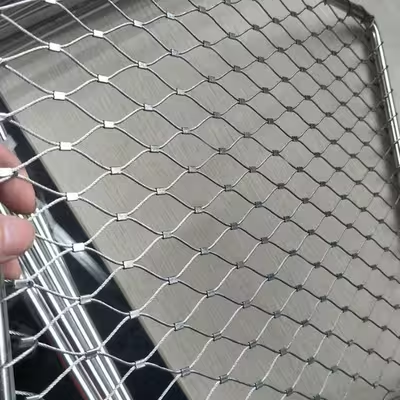
In the realm of industrial fabrication and construction material production, precision, speed, and reliability are non-negotiable. Our advanced wire mesh welding systems stand at the forefront of this demanding sector, engineered to transform raw wire into high-quality, consistent welded mesh panels with unparalleled efficiency. Designed for manufacturers of concrete reinforcement mesh (rebar mesh), fencing, grating, shelving, and various industrial wire products, our machines automate a critical process, ensuring structural integrity, dimensional accuracy, and significant cost savings. This product page details our comprehensive wire mesh welding solutions, built to meet the rigorous standards of global B2B clients and large-scale production environments.
Our wire mesh welding machines represent a fusion of robust mechanical engineering and intelligent control systems. They are designed to automate the entire process of laying longitudinal and transverse wires, precisely positioning them, and executing high-speed, high-pressure resistance welds at every intersection. This automation eliminates human error, dramatically increases output, and produces mesh with uniform weld strength and spacing. The core of our offering is adaptability; whether you require a compact model for specialty mesh or a fully automated production line with inline straightening, cutting, and stacking, we provide a wire mesh welding solution scaled to your production volume and product specifications. From reinforcing the foundations of mega-infrastructure projects to creating the essential components for agricultural and storage solutions, our machines are the reliable heart of your production floor.
| Specification Category | Model WM-50 | Model WM-150 | Model WM-300 (Heavy Duty) |
|---|---|---|---|
| Max. Welding Width | 2.4 meters | 3.2 meters | 4.0 meters |
| Wire Diameter Range (Longitudinal/Cross) | 3mm - 6mm / 3mm - 6mm | 4mm - 10mm / 4mm - 10mm | 6mm - 16mm / 6mm - 12mm |
| Mesh Spacing Range | 50mm - 300mm | 50mm - 400mm | 100mm - 500mm |
| Welding Speed (Welds/Minute) | Up to 120 | Up to 90 | Up to 70 |
| Power Supply | 380V / 50Hz / 3 Phase | 380V / 50Hz / 3 Phase | 380V / 50Hz / 3 Phase |
| Control System | PLC + HMI (Siemens/Allen-Bradley) | PLC + HMI (Siemens/Allen-Bradley) | PLC + HMI (Siemens/Allen-Bradley) |
| Typical Application | Light fencing, gabions, poultry mesh | Rebar mesh for concrete, industrial partitions | Heavy infrastructure rebar, tunnel lining mesh |
Note: Specifications are indicative. Custom configurations for specific wire mesh welding requirements are available upon consultation.
The versatility of modern wire mesh welding technology makes it indispensable across a spectrum of industries. Our machines are engineered to produce mesh that forms the backbone of critical projects worldwide.
Investing in our wire mesh welding equipment translates directly to a stronger competitive edge and a healthier bottom line.
Selecting a supplier for critical production machinery goes beyond the initial specification sheet. We are your strategic partner in manufacturing excellence.
Our wire mesh welding systems are primarily designed for low-carbon (mild) steel wire, which is standard for construction reinforcement and general-purpose mesh. We can also configure machines for welding stainless steel, galvanized wire, and other alloys with appropriate adjustments to welding parameters and, if necessary, electrode materials. Please consult with our engineers regarding your specific material requirements.
Consistency is engineered into the system. We use closed-loop, adaptive welding controls that monitor and adjust voltage and current in real-time for every weld, compensating for minor variations in wire surface condition or diameter. This ensures each weld nugget in the wire mesh welding process achieves the specified strength. Furthermore, our heavy-duty electrode design and precise pressure application guarantee uniform contact and heat distribution.
Lead times vary based on model complexity and customization, typically ranging from 12 to 20 weeks from order confirmation. Upon delivery and installation, our field engineers provide comprehensive on-site training covering machine operation, routine maintenance, basic troubleshooting, and programming for your specific mesh products. We also provide detailed digital manuals and maintenance schedules.
Absolutely. A key strength of our modular wire mesh welding systems is their ability to integrate. We can design interfaces for automated loading of wire coils from your storage, or for conveying finished mesh panels directly to bundling, stacking, or even galvanizing lines. We assess your entire workflow to ensure seamless integration.
Regular preventive maintenance is straightforward. Key tasks include periodic cleaning of welding electrodes and fixtures, checking and tightening mechanical fasteners, lubricating moving parts as per the schedule, and inspecting electrical connections. The control system often includes diagnostic functions to alert operators to required maintenance. We supply a full maintenance kit and guide with each machine.
Comprehensive Guide to Durable 316 Stainless Steel Security Screens
Understanding 12 mesh stainless steel screen Applications and Technical Details

Understanding 20 mesh stainless steel screen Applications and Performance

Understanding 30 Mesh Stainless Steel Screen Applications and Material Properties
Understanding 16 Mesh Stainless Steel Screen Applications and Performance
Ready to move your project from technical blueprint to precision reality? Whether you require large-scale CNC machining, complex structural assembly, or specialized fabrication with rare alloys like Titanium and Nickel, our engineering team is prepared to assist. At metalfabricationcn.com, we solve the manufacturing challenges that others find too large or too complex. Reach out today to discuss your specific requirements, and let us help you optimize your supply chain with ISO 9001 certified reliability.