
Understanding 20 mesh stainless steel screen Applications and Performance

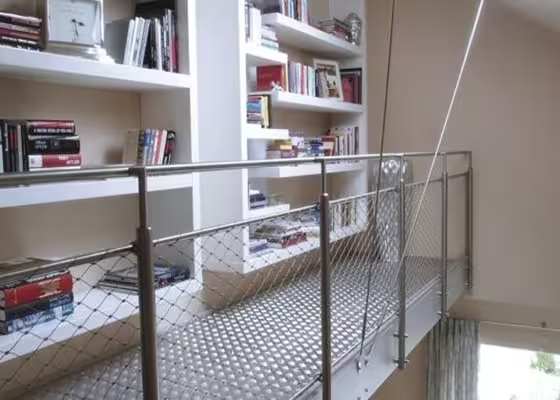
Galvanised steel wire mesh is a fundamental and highly reliable material engineered for strength, longevity, and versatility across a vast spectrum of industrial, agricultural, and construction applications. This product is manufactured from high-quality carbon steel wire, which is then woven or welded into a precise grid pattern before undergoing a critical galvanisation process. This process involves coating the finished mesh in a protective layer of zinc, creating a robust barrier against corrosion, rust, and environmental degradation. The result is a material that combines the inherent tensile strength of steel with exceptional resistance to the elements, making galvanised steel wire mesh a cost-effective and long-term solution for demanding projects. From securing perimeters to reinforcing concrete, its utility is virtually unmatched in the B2B sector, offering a perfect balance of performance, durability, and value.
Our galvanised steel wire mesh is distinguished by a set of engineered features designed to meet the rigorous demands of international trade and industrial use.
Our galvanised steel wire mesh is available in a comprehensive range of specifications to suit precise project requirements. The table below outlines our standard offerings. Custom specifications regarding wire gauge, mesh opening, width, and coating weight can be accommodated for bulk orders.
| Specification | Standard Range | Description |
|---|---|---|
| Wire Diameter (Gauge) | 10 Ga (3.5mm) to 22 Ga (0.7mm) | Thicker gauges provide higher strength for heavy-duty fencing and cages; thinner gauges are ideal for screening and light partitioning. |
| Mesh Opening (Aperture) | 1/4" (6.35mm) to 4" (101.6mm) | The clear distance between adjacent wires. Smaller openings offer finer filtration and security, while larger openings provide visibility and airflow. |
| Common Weave Types | Plain Weave, Twilled Weave, Welded | Plain weave is standard for flexibility; twilled weave offers stability with smaller wires; welded mesh provides rigid, fixed intersections. |
| Zinc Coating | Hot-Dip Galvanised (Standard) | Minimum coating mass of 60-120 g/m² for welded mesh, and higher for woven varieties, ensuring long-term rust protection. |
| Standard Sheet/Roll Width | 0.5m, 1m, 1.2m, 1.5m, 2m | Available in rolls or flat sheets. Custom widths are available to minimize on-site waste and labor. |
| Core Material | Low-Carbon Steel Wire (Q195, AISI 1008) | Provides an optimal balance of ductility and strength, ideal for forming and galvanising. |
The adaptability of galvanised steel wire mesh makes it a cornerstone material in numerous industries. Its primary function is to separate, screen, reinforce, protect, or filter, serving critical roles in the following sectors:
Choosing galvanised steel wire mesh over alternative materials provides a multitude of tangible benefits for project managers, procurement specialists, and engineers.
As a leading supplier in the international trade of industrial materials, we differentiate ourselves through a commitment to quality, service, and partnership that goes beyond mere transaction.
A: This is a crucial distinction. Galvanised Before Weaving (GBW): Individual wires are coated first, then woven. The coating can be slightly damaged at wire intersections, potentially creating micro-corrosion points. Galvanised After Weaving (GAW) / Hot-Dip Galvanised: The entire mesh panel is woven from plain steel wire and then immersed in molten zinc. This is our standard and recommended process, as it coats the entire product, including the weld or weave points, with a uniform protective layer, offering superior corrosion resistance and a longer lifespan.
A: The service life depends heavily on the environment (corrosivity category) and the zinc coating thickness. In a standard rural or urban atmosphere (C2-C3), a properly hot-dip galvanised mesh with a standard coating can last 20-50 years or more before requiring significant maintenance. In highly corrosive coastal or industrial areas (C4-C5), the lifespan is still substantially longer than that of any non-galvanised alternative. We can advise on appropriate coating weights for your specific location.
A: Absolutely. Welded galvanised steel wire mesh is extensively used as reinforcement in concrete slabs, pavements, and shotcrete applications. The galvanisation protects the steel from corrosion that can be initiated by moisture and chlorides in the concrete, preventing rust stains (spalling) and significantly enhancing the structural longevity of the concrete element, especially in bridges, parking decks, and marine structures.
A: Yes. Hot-dip galvanised coatings are generally considered safe and non-toxic. The zinc layer is stable and inert. Galvanised steel wire mesh is widely used in poultry farming, food processing plants for sorting, and in agricultural settings. For direct contact with highly acidic foods, stainless steel might be recommended, but for most animal enclosures and general food handling, it is an excellent and economical choice.
A: The key parameters are Wire Diameter (for strength), Mesh Opening Size (for the level of screening or security needed), and Coating Weight (for environmental durability). Consider the primary function: Is it for security fencing (heavier gauge, larger openings), insect screening (light gauge, very small openings), or industrial filtering (specific aperture size)? Our technical sales team is ready to assist you in analyzing your requirements and recommending the most cost-effective and performance-optimized galvanised steel wire mesh specification.
NEXT:screening wire mesh
Understanding 20 mesh stainless steel screen Applications and Performance

Understanding 12 mesh stainless steel screen Applications and Technical Details
Strategic Custom Metal Fabrication Services
Understanding the Versatility of 10 mesh stainless steel screen Applications
Understanding 16 Mesh Stainless Steel Screen Applications and Performance
Ready to move your project from technical blueprint to precision reality? Whether you require large-scale CNC machining, complex structural assembly, or specialized fabrication with rare alloys like Titanium and Nickel, our engineering team is prepared to assist. At metalfabricationcn.com, we solve the manufacturing challenges that others find too large or too complex. Reach out today to discuss your specific requirements, and let us help you optimize your supply chain with ISO 9001 certified reliability.