
Detailed Analysis of 24 mesh stainless steel screen Applications and Performance

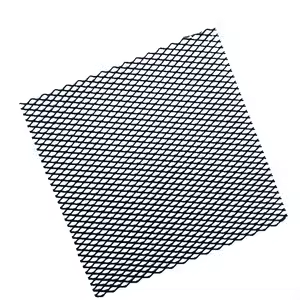
In the critical world of industrial sealing, where pressure, temperature, and chemical resistance are non-negotiable, standard gaskets often fall short. Our engineered wire mesh gaskets represent a superior sealing solution, designed to perform reliably in the most challenging environments. Unlike conventional soft-cut gaskets, these are robust, metallic seals constructed from layers of precision-woven wire mesh, often impregnated with a flexible graphite or PTFE filler. This unique construction creates a seal that is both resilient and durable, capable of conforming to flange imperfections while maintaining integrity under extreme thermal cycling and high bolt loads. As a cornerstone of modern industrial maintenance and OEM design, our wire mesh gaskets are the trusted choice for engineers and procurement specialists seeking to eliminate leakage, reduce downtime, and enhance operational safety across a vast spectrum of heavy industries.
The fundamental principle behind wire mesh gaskets is their ability to provide a "live load" sealing action. The compressible, resilient wire mesh core exerts a continuous sealing force, compensating for relaxation in bolt tension and fluctuations in system pressure and temperature. This makes them exceptionally suitable for applications involving thermal cycling, where traditional gaskets can cold-flow or creep, leading to eventual failure. We supply a comprehensive range of styles, including flat sheet, corrugated, and profile wound configurations, to meet specific pressure class, flange type, and media compatibility requirements for global industrial applications.
Our wire mesh gaskets are engineered with precision to deliver unmatched performance. Each feature is designed to address a specific challenge in industrial sealing, ensuring reliability and longevity.
The following table outlines the standard specifications for our core range of wire mesh gaskets. Custom configurations are available to meet exact OEM or retrofit requirements.
| Parameter | Specification / Range | Details |
|---|---|---|
| Core Material | Stainless Steel, Inconel, Monel, Carbon Steel | Precision-woven mesh in various weave densities and wire diameters. |
| Filler Material | Flexible Graphite, PTFE, Ceramic Fiber, None (All-Metal) | Impregnated into the mesh to enhance sealability and chemical resistance. |
| Temperature Range | -200°C to +1000°C (-328°F to +1832°F) | Dependent on material combination. Graphite-filled excels in high-temp inert atmospheres. |
| Pressure Rating | Up to 3000+ psi (200+ bar) | Suitable for ASME B16.5, B16.47, and DIN flanges across various pressure classes. |
| Standard Styles | Flat Sheet, Corrugated Metal, Profile Wound (with/without inner/outer rings) | Profile wound with centering rings is standard for high-pressure applications. |
| Standard Sizes | DN 15 to DN 1600 (1/2" to 64") | Full range of ANSI, DIN, JIS, and custom flange dimensions available. |
| Thickness | 1.5mm to 4.5mm (1/16" to 3/16") | Standard and custom thicknesses to suit specific gland depth requirements. |
| Compliance | ISO 9001:2015, API 601, ASME B16.20 | Manufactured under strict quality management systems for traceability and consistency. |
The versatility and robustness of wire mesh gaskets make them indispensable across a wide array of industries where sealing failure is not an option. Their primary function is to create a reliable, leak-tight barrier in flange connections subjected to dynamic operating conditions.
When specifying a gasket for these severe services, the engineered solution of a wire mesh gasket provides a safety margin that softer, cut gaskets cannot match, protecting personnel, capital equipment, and the environment.
Choosing the right gasket is a critical economic and safety decision. Our wire mesh gaskets offer distinct, measurable advantages over traditional alternatives like compressed non-asbestos (CNAF), rubber, or plain PTFE gaskets.
In a global market, partnership matters. We are not just a supplier; we are a technical sealing solutions provider with a deep commitment to quality, reliability, and customer success.
A: Absolutely. Wire mesh gaskets, particularly in corrugated or profile wound styles with centering rings, are perfectly suited for Raised Face (RF) flanges. The centering ring ensures proper alignment and prevents over-compression of the sealing element. They are a highly recommended upgrade over standard soft gaskets for RF applications in severe service.
A: Material selection depends on three primary factors: temperature, media (chemical compatibility), and pressure. As a rule, flexible graphite-filled stainless steel mesh handles high temperatures and steam excellently. For highly corrosive media like strong acids, a PTFE-filled Inconel mesh may be required. Our technical team can provide a detailed selection guide and recommendation based on your specific process data sheet (PDS).
A: One of the significant advantages of wire mesh gaskets is their potential for reuse, especially the all-metal or heavily constructed types. If the gasket is carefully removed without damage, the flange faces are clean and undamaged, and the gasket has not been over-compressed beyond its recovery limit, it can often be reinstalled. However, for critical services, we always recommend inspection and, if in doubt, replacement with a new gasket to guarantee seal integrity.
A: Installation torque is not generic; it depends on the gasket style, size, pressure class, and bolt material. Over-torquing can crush and destroy the gasket's resilience. We provide detailed, gasket-specific installation instructions and recommended bolt loads (in N-m or ft-lbs) with every order. Following these guidelines and using a calibrated torque wrench in a cross-pattern sequence is crucial for a successful seal.
A: Yes, full traceability is a cornerstone of our quality promise. For every order, we can provide a Certificate of Conformity (CoC) and full Mill Test Reports (MTRs) for the metallic wire and filler materials used, verifying their chemical composition and physical properties to ASTM or equivalent international standards. This documentation is essential for audit trails in regulated industries like oil & gas, power, and pharmaceuticals.
Detailed Analysis of 24 mesh stainless steel screen Applications and Performance
Understanding the Versatility of 10 mesh stainless steel screen Applications

Comprehensive Guide to Durable 316 Stainless Steel Security Screens

Understanding 100 mesh stainless steel screen for Industrial Applications
Understanding 30 Mesh Stainless Steel Screen Applications and Material Properties
Ready to move your project from technical blueprint to precision reality? Whether you require large-scale CNC machining, complex structural assembly, or specialized fabrication with rare alloys like Titanium and Nickel, our engineering team is prepared to assist. At metalfabricationcn.com, we solve the manufacturing challenges that others find too large or too complex. Reach out today to discuss your specific requirements, and let us help you optimize your supply chain with ISO 9001 certified reliability.