
Detailed Analysis of 2mm Stainless Steel Mesh Properties and Applications

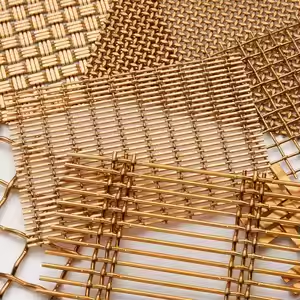
In the demanding world of construction, structural integrity is non-negotiable. Mesh wire for concrete, also known as welded wire mesh or fabric reinforcement, is a fundamental engineered product designed to provide tensile strength and crack control in concrete structures. This high-strength steel grid is manufactured through a precise automated welding process, creating a consistent and reliable reinforcement material that is integral to projects ranging from residential slabs to massive industrial complexes. As a leading supplier in the global construction supply chain, we provide premium-grade mesh wire for concrete that meets and exceeds international standards, ensuring your builds are durable, safe, and cost-effective.
Our mesh wire for concrete is manufactured from cold-drawn, low-carbon or high-tensile steel wires arranged in perpendicular directions and welded at every intersection. This process creates a rigid, integrated grid that acts as a secondary skeleton within the concrete pour. Unlike loose rebar, which requires extensive tying and manual placement, welded wire mesh arrives in ready-to-use sheets or rolls, significantly reducing labor time and potential for human error. The primary function of mesh wire for concrete is to absorb tensile stresses—forces that cause stretching and cracking—which plain concrete is notoriously weak against. By distributing loads evenly and minimizing crack propagation, it dramatically enhances the longevity and performance of concrete elements. Our product range is comprehensive, catering to light-duty applications like patio slabs as well as heavy-duty requirements for roads, airport runways, and pre-cast concrete panels.
Our mesh wire for concrete is produced in strict compliance with international standards such as ASTM A185/A185M, ASTM A497/A497M, BS 4483, and AS/NZS 4671. The specifications below outline our core product range. Custom sizes, wire diameters, and sheet dimensions are available upon request for large-scale or specialized projects.
| Model / Standard Designation | Wire Diameter (Longitudinal/Cross) (mm) | Mesh Spacing (Longitudinal/Cross) (mm) | Sheet Dimensions (Standard) (m) | Typical Yield Strength (MPa) | Primary Application Grade |
|---|---|---|---|---|---|
| A142 (Square Mesh) | 6.0 / 6.0 | 200 / 200 | 2.4 x 6.0 / 2.4 x 12.0 | ≥ 500 | Light Duty: Domestic slabs, paths |
| A193 (Square Mesh) | 7.0 / 7.0 | 100 / 100 | 2.4 x 6.0 / 2.4 x 12.0 | ≥ 500 | Medium Duty: Heavier domestic, light commercial |
| A252 (Structural Mesh) | 8.0 / 8.0 | 100 / 200 | 2.4 x 6.0 / 2.4 x 12.0 | ≥ 500 | Heavy Duty: Industrial floors, raft foundations |
| A393 (Structural Mesh) | 10.0 / 10.0 | 100 / 100 | 2.4 x 6.0 / 2.4 x 12.0 | ≥ 500 | Extra Heavy Duty: Hard-standing, roads |
| D49 (High-Tensile) | 5.0 / 5.0 | 100 / 100 | 2.4 x 6.0 / 2.4 x 12.0 | ≥ 650 | High-Strength: Pre-cast elements, specialized slabs |
| Rolled Mesh (Standard) | 3.0 - 5.0 | 50x50 / 100x100 / 150x150 | Rolls: 2.0m width x 50m length | ≥ 500 | Curved surfaces, large area pours, fencing |
The versatility of mesh wire for concrete makes it indispensable across the construction spectrum. Its primary role is to reinforce concrete against cracking and tensile failure.
Choosing the right mesh wire for concrete translates directly into project success. Our product delivers multifaceted benefits:
In a global market, partnership with a reliable and expert supplier is key. We distinguish ourselves through an unwavering commitment to quality, service, and client success.
Sheet mesh is rigid and flat, typically used for large, flat areas like slabs where its stiffness aids in positioning. Rolled mesh is flexible, supplied in coils, and is ideal for covering large or curved surfaces more quickly, or for applications like fencing. The choice depends on the project's specific requirements for handling and placement.
The specification should always be determined by a qualified structural engineer based on the design loads, slab thickness, and concrete grade. Common designations like A193 or A252 refer to the cross-sectional area of steel per meter. We provide detailed technical data sheets and our experts can assist in interpreting project specifications to ensure you receive the perfectly suited product.
Galvanized mesh (zinc-coated) offers excellent corrosion resistance for most environments, including those with moderate exposure to moisture or de-icing salts. For highly aggressive environments, such as marine splash zones or chemical exposure, epoxy-coated or stainless steel options should be considered for maximum longevity.
Sheets should be stored flat on level, dry ground with timber bearers to prevent contact with mud and water. Rolls should be stored on their edges. Use appropriate lifting equipment (e.g., spreader bars) to avoid bending sheets during handling. Protect the mesh from contamination before the concrete pour to ensure optimal bond strength.
Yes, absolutely. We provide full material test certificates (MTCs) or mill test reports with every major shipment, detailing the chemical composition, physical properties, and results of weld shear tests. This documentation is crucial for quality assurance and compliance with project specifications.
Lead times vary based on the product specification and order volume. For standard items, we can often ship within 7-14 days. We cater to both large-scale project orders and smaller container loads (FCL), with flexible MOQs. Contact our sales team with your project details for a precise and competitive quotation tailored to your needs.
PREV:rebar and wire mesh
NEXT:woven wire mesh 3d
Detailed Analysis of 2mm Stainless Steel Mesh Properties and Applications

Understanding 16 Mesh Stainless Steel Screen Applications and Performance
Detailed Analysis of 24 mesh stainless steel screen Applications and Performance
Understanding 300 Mesh Stainless Steel Screen Applications and Performance
Understanding 12 mesh stainless steel screen Applications and Technical Details
Ready to move your project from technical blueprint to precision reality? Whether you require large-scale CNC machining, complex structural assembly, or specialized fabrication with rare alloys like Titanium and Nickel, our engineering team is prepared to assist. At metalfabricationcn.com, we solve the manufacturing challenges that others find too large or too complex. Reach out today to discuss your specific requirements, and let us help you optimize your supply chain with ISO 9001 certified reliability.