
Understanding 100 mesh stainless steel screen for Industrial Applications

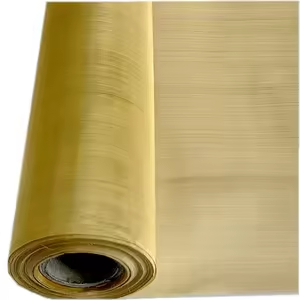
In the realm of durable and resilient construction, the synergy between wire mesh and concrete stands as a cornerstone of modern engineering. This powerful composite material combines the formidable compressive strength of concrete with the exceptional tensile reinforcement provided by welded wire mesh. The result is a structural element that resists cracking, controls shrinkage, and significantly enhances load distribution. This product page is dedicated to providing international builders, contractors, and procurement specialists with a comprehensive understanding of our premium welded wire mesh products, engineered specifically for integration with concrete to create structures of unparalleled integrity and longevity. From expansive industrial floors and high-traffic pavements to critical structural walls and precast elements, our solutions are designed to meet the most demanding global standards.
Our welded wire mesh for concrete is a factory-fabricated grid of high-tensile steel wires, precision-welded at every intersection. Manufactured under stringent quality controls, it is supplied in rolls or sheets (panels) ready for direct placement within concrete formwork. Unlike loose rebar, which requires tedious on-site tying, welded wire mesh offers a consistent, high-quality reinforcement layer that dramatically reduces labor time and potential installation errors. The primary function of wire mesh and concrete systems is to work as a unified composite: the concrete bears compressive forces, while the mesh absorbs tensile stresses, thermal expansion, and shrinkage forces that concrete alone cannot withstand. This partnership is fundamental for preventing random cracking, improving impact resistance, and ensuring the structural slab or element performs as a single, monolithic unit under stress.
Our welded wire mesh is produced in accordance with international standards such as ASTM A185/A497, BS 4483, and ISO 10544. The specifications below cover our most commonly requested product range. Custom sizes, wire diameters, and sheet dimensions are available upon request for large-scale or specialized projects.
| Model Designation | Wire Diameter (mm) | Grid Spacing (mm) | Sheet Size (m) | Cross-Sectional Area (sq. mm/m) | Primary Application |
|---|---|---|---|---|---|
| A142 | 6.0 | 200 x 200 | 2.4 x 6.0 | 142 | Light duty slabs, paths, domestic floors |
| A193 | 7.0 | 200 x 200 | 2.4 x 6.0 | 193 | Medium duty floors, foundations, raft slabs |
| A252 | 8.0 | 200 x 200 | 2.4 x 6.0 | 252 | Heavy industrial floors, warehouse slabs, paving |
| A393 | 10.0 | 200 x 200 | 2.4 x 6.0 | 393 | Heavy-duty paving, airport aprons, structural walls |
| D49 / D98 (Wraparound Mesh) | 2.5 - 5.0 | 100 x 100 / 50 x 50 | Rolls (2.1m x 50m) | 49 - 98 | Thin section concrete, pipe coating, cladding reinforcement |
Note: All wire is compliant with a minimum yield strength of 500 N/mm². Galvanized coating typically complies with a minimum of 260 g/sqm (Class A).
The versatility of wire mesh and concrete makes it indispensable across a vast spectrum of construction projects. Its primary role is to provide robust, reliable reinforcement in applications where cracking and structural integrity are paramount concerns.
Choosing our welded wire mesh for your concrete projects delivers a multitude of technical, economic, and logistical benefits that translate directly to project success.
In a global market, selecting the right supplier is as crucial as selecting the right material. We distinguish ourselves not just as a manufacturer, but as a technical partner dedicated to the success of your project.
Rebar is typically used for primary structural reinforcement in beams, columns, and heavily loaded elements, where it is placed in specific patterns. Welded wire mesh is designed for slab-on-grade applications, walls, and paving, where it provides a uniform layer of secondary reinforcement primarily for crack control and temperature/shrinkage stresses. Mesh offers faster installation and more consistent quality, while rebar offers greater flexibility in complex shapes.
The specification is determined by the structural engineer based on the design loads, slab thickness, and subgrade conditions. Common designations like A193 or A252 refer to the cross-sectional area of steel per meter width. It is critical to consult your project's structural drawings. Our technical team can assist in interpreting specifications and recommending the optimal product.
For ground-supported slabs, welded wire mesh should be positioned in the upper third of the slab, typically 2-3 inches below the surface. This placement is most effective for controlling shrinkage cracks that originate at the surface. It must be adequately supported on chairs or dobies during the concrete pour to ensure correct positioning.
Absolutely. For projects in coastal areas, chemical plants, or where de-icing salts are used, we strongly recommend our hot-dip galvanized (zinc-coated) wire mesh. The zinc coating provides a sacrificial layer of protection, dramatically extending the service life of the wire mesh and concrete composite in corrosive conditions.
Standard mesh sheets are bundled securely with steel strapping on wooden pallets for safe ocean freight. Rolls are packed in sturdy wooden crates. Lead times vary by order volume and specification but typically range from 14-30 days for production, plus transit time. We provide a clear shipping schedule with every confirmed order.
Yes, our production line is highly adaptable. We regularly produce mesh with non-standard wire diameters, grid spacings (rectangular or square), and sheet dimensions to suit specific formwork or design requirements. Please provide your detailed drawings or specifications for a custom quotation.
PREV:bird cage wire mesh
NEXT:rebar and wire mesh
Understanding 100 mesh stainless steel screen for Industrial Applications

Comprehensive Guide to Durable 316 Stainless Steel Security Screens
Detailed Analysis of 2mm Stainless Steel Mesh Properties and Applications

Understanding 300 Mesh Stainless Steel Screen Applications and Performance
Understanding 30 Mesh Stainless Steel Screen Applications and Material Properties
Ready to move your project from technical blueprint to precision reality? Whether you require large-scale CNC machining, complex structural assembly, or specialized fabrication with rare alloys like Titanium and Nickel, our engineering team is prepared to assist. At metalfabricationcn.com, we solve the manufacturing challenges that others find too large or too complex. Reach out today to discuss your specific requirements, and let us help you optimize your supply chain with ISO 9001 certified reliability.