
Detailed Analysis of 24 mesh stainless steel screen Applications and Performance

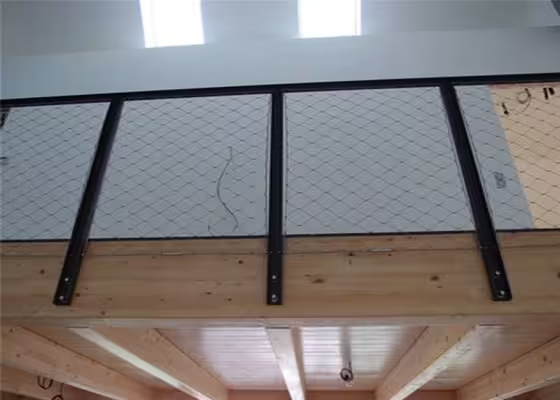
In demanding industrial and commercial environments, the integrity of structural and protective components is paramount. Our corrosion resistant wire mesh is engineered to provide a superior, long-lasting barrier solution that stands up to the harshest conditions. This specialized mesh is manufactured from high-grade alloys and treated with advanced protective coatings, creating a product that resists degradation from moisture, chemicals, salt spray, and extreme temperatures. Unlike standard wire mesh, which can rust and weaken rapidly, our corrosion resistant variants are designed for longevity, reducing maintenance costs and ensuring reliable performance over extended service life. Whether used for filtration, screening, reinforcement, or safety, this mesh delivers unmatched durability and value for a wide range of international B2B applications.
| Parameter | Specification Details | Available Options / Standards |
|---|---|---|
| Base Material | Defines core resistance properties. | Stainless Steel 304/316, Aluminum 5052/6061, Galvanized Low-Carbon Steel |
| Mesh Count | Number of openings per linear inch. | 2 Mesh - 200 Mesh (custom sizes available) |
| Wire Diameter | Thickness of the individual wires. | 0.025 mm - 5.0 mm (SWG & BWG standards) |
| Weave Type | Determines strength, flexibility, and surface profile. | Plain Weave, Twill Weave, Welded, Dutch Weave |
| Coating / Finish | Additional protective layer for enhanced durability. | Hot-Dip Galvanized (Zn), PVC Coated, Powder Coated, Electro-Galvanized |
| Panel Dimensions | Standard sheet or roll sizes. | 1m x 30m (Rolls), 1.2m x 2.4m (Sheets), Fully Customizable |
| Temperature Resistance | Operational range without performance loss. | -40°C to 1100°C (varies by material; SS316 highest) |
| Industry Standards | Compliance with international quality benchmarks. | ASTM, ISO 9001, DIN, RoHS Compliant |
The robustness of corrosion resistant wire mesh makes it an indispensable component across a multitude of sectors. In chemical processing and petrochemical plants, it is used for catalyst support, filtration of corrosive fluids, and safety grating around equipment. The marine and offshore industries rely on it for protective screens, fish farming cages, and architectural elements on ships and docks, where saltwater exposure is constant. For water treatment facilities, this mesh serves as intake screens, filter media, and sludge dewatering belts. In agriculture and food processing, its hygienic, rust-proof properties are ideal for sorting, drying, and conveying equipment. Furthermore, architectural and construction projects utilize it for durable facades, balcony infills, and landscape reinforcement in coastal or high-pollution areas. Each application benefits from the mesh's core promise: enduring strength in the face of corrosive elements.
The primary advantage of investing in high-quality corrosion resistant wire mesh is its extended service life. By resisting rust and chemical degradation, it avoids the common failure points of standard mesh, ensuring your infrastructure or product remains secure and functional for years, not months.
While the initial investment may be higher than standard mesh, the total cost of ownership is significantly lower. Reduced frequency of replacement, minimal maintenance requirements, and avoidance of downtime due to mesh failure translate into substantial long-term savings and a higher return on investment.
In safety-critical applications like platform flooring, machine guards, or filtration in volatile processes, material failure is not an option. Our mesh provides reliable, predictable performance, ensuring worker safety and protecting valuable assets from damage caused by structural compromise.
With a wide array of materials, weaves, and coatings, our corrosion resistant wire mesh can be precisely engineered to meet specific load-bearing, flow-rate, visibility, and environmental resistance requirements, offering designers and engineers a versatile material solution.
Selecting the right supplier for corrosion resistant wire mesh is as critical as specifying the product itself. As a specialist manufacturer and global exporter, we distinguish ourselves through an unwavering commitment to quality and client success. Our in-house metallurgical expertise allows us to consult on the optimal material and coating combination for your specific environment, ensuring you get a solution, not just a product. We operate a state-of-the-art manufacturing facility with strict quality control protocols at every stage, from raw material sourcing to final packaging, guaranteeing compliance with international ASTM and ISO standards.
We understand the complexities of international trade. Our dedicated logistics team manages seamless export documentation, timely shipping, and reliable delivery to your port or doorstep. Furthermore, we offer unparalleled customization – able to produce non-standard sizes, hybrid weaves, and tailored finishes to meet unique project blueprints. When you partner with us, you gain more than a supplier; you gain a technical partner dedicated to ensuring your project's success with the most durable and effective corrosion resistant wire mesh on the market.
A: Both offer excellent resistance, but through different mechanisms. Galvanized mesh is carbon steel coated with a thick layer of zinc, providing sacrificial protection. It is cost-effective for many environments but can be compromised if the coating is scratched. Stainless steel (especially 316 grade) is an alloy inherently resistant to corrosion throughout its entire thickness, making it superior for highly corrosive or high-temperature applications, though at a higher initial cost. The choice depends on your specific chemical exposure, budget, and required lifespan.
A: Selection is based on functional requirements. Mesh count (openings per inch) determines the size of particles that can pass through. A higher count means smaller openings for fine filtration or screening. Wire diameter directly impacts strength and durability; thicker wires create a heavier, more rigid mesh suitable for load-bearing or impact resistance, while thinner wires offer greater flexibility and finer filtration. Our technical team can assist you in balancing these parameters for optimal performance.
A: Yes, absolutely. Our mesh can be custom-cut, shaped, framed, or welded to your specifications before shipment. For welded constructions like gratings or baskets, we often recommend using the same base material for the frame (e.g., stainless steel rods) to maintain uniform corrosion resistance. We offer comprehensive fabrication services to deliver ready-to-install components, saving you time and labor costs.
A: For standard specifications from our catalog, lead times are typically short. Custom orders involving unique sizes, materials, or coatings require additional production time, which we will outline in your formal quotation. We pride ourselves on flexibility and work with clients of all scales; while we have standard MOQs to ensure efficiency, we are committed to finding solutions for project-specific needs and welcome discussions for both large industrial contracts and smaller pilot projects.
A: Even the most corrosion resistant wire mesh should be stored properly to preserve its condition. Store panels or rolls in a dry, covered warehouse away from standing water and corrosive chemical fumes. Avoid dragging mesh over abrasive surfaces, which could scratch protective coatings. Use appropriate lifting equipment for heavy rolls. For coated meshes like PVC, protect from prolonged direct sunlight during storage. Following these simple guidelines ensures the product performs as designed once installed.
PREV:chimney wire mesh
NEXT:w1.4 wire mesh
Detailed Analysis of 24 mesh stainless steel screen Applications and Performance

Understanding 100 mesh stainless steel screen for Industrial Applications
Understanding 30 Mesh Stainless Steel Screen Applications and Material Properties

Understanding 1mm Stainless Steel Wire Mesh for Filtration and Industrial Applications
Understanding 16 Mesh Stainless Steel Screen Applications and Performance
Ready to move your project from technical blueprint to precision reality? Whether you require large-scale CNC machining, complex structural assembly, or specialized fabrication with rare alloys like Titanium and Nickel, our engineering team is prepared to assist. At metalfabricationcn.com, we solve the manufacturing challenges that others find too large or too complex. Reach out today to discuss your specific requirements, and let us help you optimize your supply chain with ISO 9001 certified reliability.