
Understanding 12 mesh stainless steel screen Applications and Technical Details

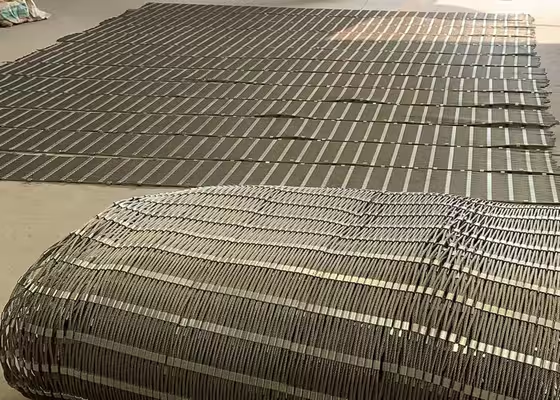
Stainless steel fine wire mesh is an engineered industrial fabric, meticulously woven from high-grade stainless steel wires into a uniform grid of precise apertures. This product category represents the pinnacle of durability and precision in industrial filtration, sieving, and separation. Unlike standard meshes, stainless steel fine wire mesh is characterized by its exceptionally small opening sizes and fine wire diameters, enabling it to capture minute particles while maintaining robust structural integrity. It is the material of choice for industries where reliability under demanding conditions—such as high temperatures, corrosive environments, and continuous mechanical stress—is non-negotiable. Our meshes are manufactured to exacting international standards, ensuring consistent performance for critical applications from aerospace to pharmaceuticals.
The superior performance of our stainless steel fine wire mesh stems from a combination of advanced manufacturing and premium material properties. These features ensure it delivers unmatched value in the most challenging operational settings.
Our stainless steel fine wire mesh is available in a comprehensive range of specifications to meet diverse industrial needs. The table below outlines our standard offerings. Custom weaves, alloys, and dimensions are available upon request for specialized projects.
| Parameter | Specifications & Range | Notes |
|---|---|---|
| Material Grade | AISI 304, 304L, 316, 316L, 321, 430 | 316/L is recommended for highly corrosive or marine environments. |
| Mesh Count | 20 to 635 Mesh (per linear inch) | Defines the number of openings per inch. Higher count equals finer filtration. |
| Wire Diameter | 0.025 mm to 0.56 mm | Finer wires used for higher mesh counts; thicker wires for added strength. |
| Micron Rating | 10 µm to 1000 µm | Absolute filtration rating indicating the size of the largest spherical particle that will pass through. |
| Weave Type | Plain Weave, Twilled Weave, Dutch Weave | Plain weave is standard. Twilled offers stability for fine wires. Dutch weave provides exceptional strength and fine filtration. |
| Standard Width | Up to 2000 mm (78.7 inches) | Minimizes seams in large filter assemblies. |
| Roll Length | Standard 30 meters, custom lengths available | Optimized for production efficiency. |
The versatility and reliability of stainless steel fine wire mesh make it indispensable across a vast spectrum of industries. Its primary function is to provide precise separation, filtration, and protection.
Choosing stainless steel fine wire mesh over polymer screens or other metal meshes provides a decisive competitive edge in terms of performance, longevity, and total cost of ownership.
In the global industrial marketplace, selecting the right partner for your stainless steel fine wire mesh is as crucial as selecting the material itself. We distinguish ourselves through an unwavering commitment to quality, expertise, and customer success.
A: Mesh count refers to the number of openings per linear inch. Micron rating indicates the size of the opening in micrometers (µm). While related, they are not directly interchangeable due to variations in wire diameter. For precise filtration requirements, the absolute micron rating is the critical specification. Our technical datasheets provide both values for clarity.
A: AISI 304 is an excellent general-purpose, cost-effective alloy resistant to most oxidizers. Choose AISI 316 or 316L (low carbon) when your application involves exposure to chlorides, saline environments (e.g., marine, coastal), or stronger acids. The added molybdenum in 316 provides significantly enhanced corrosion resistance.
A: Absolutely. Our in-house fabrication workshop is equipped to cut, bend, roll, and weld the mesh into cylinders, cones, baskets, flat panels, and other custom geometries. We provide finished components that integrate seamlessly into your equipment, complete with flanges, handles, or frames as specified.
A: For standard specifications, we typically ship from stock within 3-5 business days. Custom weaves, special alloys, or large-volume projects require production scheduling. Our sales team provides accurate lead times upon quotation, and we are committed to meeting your project timelines through proactive planning and communication.
A: Maintenance depends on the contaminant. Common methods include ultrasonic cleaning, back-pulsing with air or liquid, chemical soaking (using appropriate cleaners for stainless steel), or gentle brushing. Avoid abrasive tools that can damage the wire surface. Regular maintenance prevents blinding and extends service life significantly.
Understanding 12 mesh stainless steel screen Applications and Technical Details

Understanding 20 mesh stainless steel screen Applications and Performance
Strategic Custom Metal Fabrication Services

Understanding 1mm Stainless Steel Wire Mesh for Filtration and Industrial Applications

Understanding 30 Mesh Stainless Steel Screen Applications and Material Properties
Ready to move your project from technical blueprint to precision reality? Whether you require large-scale CNC machining, complex structural assembly, or specialized fabrication with rare alloys like Titanium and Nickel, our engineering team is prepared to assist. At metalfabricationcn.com, we solve the manufacturing challenges that others find too large or too complex. Reach out today to discuss your specific requirements, and let us help you optimize your supply chain with ISO 9001 certified reliability.