
Understanding 12 mesh stainless steel screen Applications and Technical Details

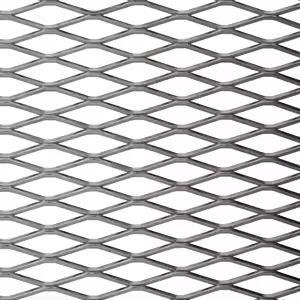
In the world of reinforced concrete, the debate between fiber mesh concrete vs wire mesh is central to project planning and material selection. Both are engineered to control cracking and enhance the structural integrity of concrete slabs, but they represent fundamentally different approaches to reinforcement. This comprehensive guide provides industrial buyers, contractors, and engineers with the critical information needed to make an informed decision. We will dissect the properties, applications, and economic implications of each system, empowering you to specify the optimal reinforcement solution for durability, performance, and cost-efficiency.
Concrete, while exceptional in compression, is inherently weak in tension, leading to plastic shrinkage and long-term cracking. Reinforcement is non-negotiable for quality outcomes. The fiber mesh concrete vs wire mesh comparison pits a traditional, discrete reinforcing system against a modern, integral one. Wire mesh (welded wire fabric or WWF) is a grid of steel wires welded at intersections, placed within the concrete form before pouring. Fiber mesh, typically comprising synthetic (polypropylene), steel, or glass fibers, is uniformly dispersed throughout the concrete mix during batching. This fundamental difference in application—placement vs. mixture—drives variations in performance, labor requirements, and final concrete behavior, making the choice between them a pivotal project specification.
The following table provides a clear, technical breakdown of the primary characteristics in the fiber mesh concrete vs wire mesh evaluation. Specifications can vary by manufacturer and project requirements.
| Parameter | Fiber Mesh (Synthetic/Polypropylene) | Fiber Mesh (Steel) | Welded Wire Mesh (WWF) |
|---|---|---|---|
| Primary Function | Control of plastic & shrinkage cracking; secondary reinforcement. | Control of plastic, shrinkage, & structural cracking; can replace light WWF. | Structural crack control; temperature & shrinkage reinforcement. |
| Form & Integration | Discrete fibers, bulk-dosed into mix. Integral to matrix. | Discrete fibers, bulk-dosed into mix. Integral to matrix. | Sheet or roll. Discrete, placed layer within slab. |
| Placement Labor | Very Low (added at plant or site mixer). | Very Low (added at plant or site mixer). | High (requires handling, positioning, tying, and chairs). |
| Crack Control | Excellent for early-age micro-cracks. Reduces crack width. | Superior for both early-age and long-term crack width control. | Effective for planned crack control at joints. Less effective for random cracking. |
| Impact on Workability | Minimal with modern fiber technology. | Can reduce slump; requires proper mix design. | No direct effect, but placement can hinder pour and finishing. |
| Corrosion Resistance | Inert. Will not corrode. | Stainless or galvanized options available; carbon steel can corrode. | Prone to corrosion if not properly positioned or if cover is inadequate. |
| Ideal Applications | Slabs-on-grade, paving, precast, overlays, where early crack control is key. | Industrial floors, heavy-duty paving, shotcrete, blast-resistant structures. | Conventional slabs, residential foundations, where design codes specify WWF. |
Choosing correctly in the fiber mesh concrete vs wire mesh decision requires matching the material to the project's specific demands.
When your analysis of fiber mesh concrete vs wire mesh points towards the modern, efficient, and high-performance benefits of fiber reinforcement, partnering with the right supplier is critical. We are a leading international manufacturer with a proven track record in supplying engineered fiber solutions for major infrastructure and industrial projects worldwide.
In many applications, yes—and it often performs better. Synthetic fibers are widely accepted as a direct replacement for light wire mesh (e.g., 6x6 W1.4xW1.4) in slabs-on-grade for crack control. Structural steel fibers are increasingly used to replace heavier wire mesh or even rebar in industrial floors and certain structural elements. The replacement must be based on an engineered design equivalency, not a simple material substitution, which our technical team can assist with.
When considering only the raw material cost per cubic yard, fiber-concrete can have a higher upfront cost. However, the total installed cost is frequently lower. The significant savings in labor (no mesh placement), time, and equipment, coupled with reduced long-term maintenance from better crack control, almost always results in a superior lifetime cost and return on investment. A holistic project analysis is essential.
With modern fiber technology and proper mix design, this is largely a myth. Early-generation fibers could clump or "hair" on the surface. Today's high-dispersion synthetic and engineered steel fibers are designed to integrate seamlessly. Following recommended finishing practices (e.g., not overworking the surface) ensures a smooth, dense finish comparable to plain concrete.
Specification should be performance-based rather than prescriptive. Instead of specifying a weight of fiber per cubic yard, specify the required performance outcome: e.g., "The concrete shall contain fiber reinforcement sufficient to provide equivalent or superior crack control to WWF [specify gauge] as per ASTM C78 or relevant performance tests." We provide detailed guide specifications and test data to support this process.
Corrosion resistance is a valid concern. We offer a range of solutions: galvanized steel fibers, stainless steel fibers for highly corrosive environments, and synthetic macro-fibers that provide structural performance without any corrosion risk. The choice depends on the exposure conditions and project lifespan requirements.
Understanding 12 mesh stainless steel screen Applications and Technical Details

Detailed Analysis of 24 mesh stainless steel screen Applications and Performance
Strategic Custom Metal Fabrication Services
Understanding the Versatility of 10 mesh stainless steel screen Applications
Understanding 16 Mesh Stainless Steel Screen Applications and Performance
Ready to move your project from technical blueprint to precision reality? Whether you require large-scale CNC machining, complex structural assembly, or specialized fabrication with rare alloys like Titanium and Nickel, our engineering team is prepared to assist. At metalfabricationcn.com, we solve the manufacturing challenges that others find too large or too complex. Reach out today to discuss your specific requirements, and let us help you optimize your supply chain with ISO 9001 certified reliability.