
Detailed Analysis of 24 mesh stainless steel screen Applications and Performance

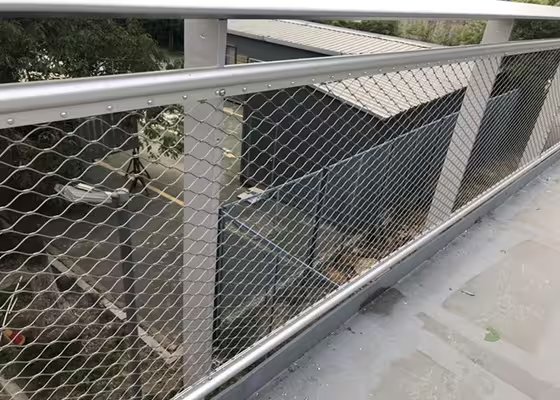
In the demanding world of industrial manufacturing, filtration, and construction, material integrity is non-negotiable. Welded stainless wire mesh stands as a cornerstone material, engineered to deliver unparalleled strength, corrosion resistance, and dimensional stability. This high-performance mesh is manufactured by precision-welding individual stainless steel wires at every intersection, creating a rigid, uniform grid structure. Unlike woven alternatives, the welded construction eliminates movement at the joints, providing exceptional load-bearing capacity and a consistently smooth surface. Ideal for both functional and architectural applications, welded stainless wire mesh from a trusted supplier is a critical component in ensuring safety, efficiency, and longevity in countless industrial processes. This product page details why our welded stainless wire mesh is the preferred choice for engineers and procurement specialists worldwide.
Our welded stainless wire mesh is manufactured to exceed international standards, offering a combination of properties that make it indispensable for rigorous applications. Each feature is designed to address specific industrial challenges, from harsh chemical environments to heavy mechanical stress.
Our welded stainless wire mesh is available in a comprehensive range of specifications to meet diverse project requirements. The table below outlines our standard offerings. Custom specifications regarding wire gauge, mesh count, sheet size, and alloy are available upon request for large-volume orders.
| Parameter | Specification Range | Notes |
|---|---|---|
| Primary Material | AISI 304, 304L, 316, 316L Stainless Steel | 316/L offers superior pitting resistance in chloride environments. |
| Wire Diameter (Gauge) | 0.5 mm (24 AWG) to 4.0 mm (6 AWG) | Thicker wires provide greater strength and rigidity. |
| Mesh Opening (Aperture) | 1/8" (3.15 mm) to 4" (101.6 mm) | Available in square or rectangular configurations. |
| Sheet/Panel Dimensions | Standard: 48" x 96" (1.2m x 2.4m) Custom: Up to 60" x 120" (1.5m x 3m) |
Larger panels reduce on-site welding and labor costs. |
| Welding Type | Precision Resistance Welding | Ensures strong, consistent welds at every intersection. |
| Surface Finish | Mill Finish, Electropolished, Powder Coated | Electropolishing enhances corrosion resistance and cleanability. |
| Tolerance | ±5% on wire diameter, ±2% on mesh opening | Stringent QC ensures batch-to-batch consistency. |
The versatility of welded stainless wire mesh makes it a critical component across a vast spectrum of industries. Its unique blend of strength, durability, and permeability solves complex engineering challenges.
Used in machine guarding, safety partitions, ventilation screens, conveyor belts, and grating. The robust welded stainless wire mesh protects personnel and equipment while allowing for airflow and visibility.
Essential in oil and gas, chemical processing, and water treatment plants as filter screens, sieve plates, and catalyst supports. The precise apertures and chemical inertness are paramount.
Employed in building facades, sunscreens, balcony infill, stair treads, and decorative interior features. It provides security, shading, and a contemporary aesthetic.
Ideal for drying racks, sorting belts, fryer baskets, and protective screens in compliance with FDA and USDA hygiene standards. The easy-clean surface is a mandatory requirement.
Used in animal cages, poultry flooring, fencing, and sorting grids. The corrosion resistance withstands organic acids and cleaning regimens.
Fabricated into secure partitions, locker mesh, shelving units, and tool cribs. The welded construction provides a formidable barrier against theft and damage.
Choosing the right mesh material impacts project cost, maintenance, and lifecycle. Our welded stainless wire mesh offers distinct advantages that deliver long-term value.
Investing in high-quality welded stainless wire mesh translates to lower total cost of ownership, reduced downtime for replacements, and enhanced operational safety.
In a global market, selecting a supplier is as critical as selecting the material. We differentiate ourselves through a commitment to quality, service, and technical partnership that ensures your project's success from specification to delivery.
A: Both are austenitic and offer good corrosion resistance. AISI 304 is the standard "marine-grade" alloy suitable for most environments. AISI 316 contains molybdenum, which provides significantly enhanced resistance to chlorides and acids (e.g., saltwater, chemical processing). For harsh or coastal applications, 316 welded stainless wire mesh is recommended.
A: Absolutely. We offer extensive value-added services, including precision cutting, bending, rolling, and frame welding. Send us your drawings, and our fabrication team will provide a solution-ready component, saving you time and labor on-site.
A: The selection depends on your primary requirement: Filtration/Sieving requires a specific aperture size to separate particles. Structural Support requires a thicker wire diameter and smaller opening for strength. Security balances aperture size (to prevent passage) with wire gauge for rigidity. Our technical team can guide you based on your load, flow, or barrier specifications.
A: For standard specification welded stainless wire mesh from stock, lead times are typically 5-10 working days. Custom alloys, sizes, or fabricated projects require additional time, which we will outline in your formal quotation. We prioritize communication to align with your project timeline.
A: Yes, we encourage it. We offer small sample swatches of our welded stainless wire mesh free of charge so you can verify quality, dimensions, and suitability for your application. For larger test panels, a nominal fee may apply, which is often credited against a future order.
A: Maintenance is minimal. For most environments, occasional rinsing with water is sufficient. For grease or stubborn deposits, a mild detergent or specialized stainless steel cleaner can be used. Avoid abrasive pads or chloride-based cleaners. Regular inspection for physical damage is good practice in high-impact areas.
Detailed Analysis of 24 mesh stainless steel screen Applications and Performance

Understanding 12 mesh stainless steel screen Applications and Technical Details

Understanding 1mm Stainless Steel Wire Mesh for Filtration and Industrial Applications
Comprehensive Guide to Durable 316 Stainless Steel Security Screens
Understanding 16 Mesh Stainless Steel Screen Applications and Performance
Ready to move your project from technical blueprint to precision reality? Whether you require large-scale CNC machining, complex structural assembly, or specialized fabrication with rare alloys like Titanium and Nickel, our engineering team is prepared to assist. At metalfabricationcn.com, we solve the manufacturing challenges that others find too large or too complex. Reach out today to discuss your specific requirements, and let us help you optimize your supply chain with ISO 9001 certified reliability.