
Understanding 12 mesh stainless steel screen Applications and Technical Details

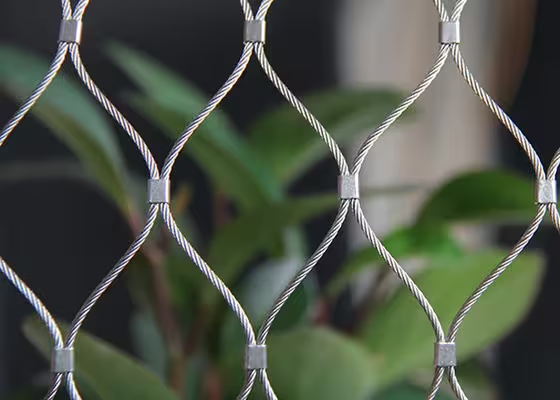
In the realm of robust and reliable construction, the foundation of any durable concrete structure lies in its reinforcement. Wire concrete mesh, also known as welded wire fabric (WWF) or welded wire reinforcement (WWR), stands as a cornerstone material for engineers, contractors, and builders worldwide. This prefabricated grid of steel wires, welded at all intersections, provides unparalleled tensile strength to concrete slabs, walls, and pavements, effectively combating the inherent weakness of concrete under tension. Our high-quality wire concrete mesh is manufactured under stringent quality controls, ensuring consistent performance, ease of installation, and long-term structural integrity for projects ranging from residential driveways to massive industrial complexes. This page details why our product is the preferred choice for professionals in the global construction supply chain.
Wire concrete mesh is a factory-manufactured reinforcement material composed of longitudinal and transverse steel wires arranged at right angles and welded together at every intersection. This process creates a rigid, high-strength grid that is delivered to the construction site in sheets or rolls, ready for placement. The primary function of wire concrete mesh is to absorb tensile, shear, and torsional stresses that plain concrete cannot withstand, thereby preventing cracking and structural failure. It is a critical component in reinforced concrete design, offering a faster, more cost-effective, and less labor-intensive alternative to hand-tied rebar mats for many applications. Our product line encompasses a wide range of wire diameters, mesh spacings, and sheet sizes, all customizable to meet precise project specifications and international standards, ensuring compatibility with any architectural or engineering requirement.
Our wire concrete mesh is produced in accordance with major international standards including ASTM A185/A497, BS 4483, and AS/NZS 4671. The table below outlines our standard product range. Custom specifications for wire grade, spacing, and sheet dimensions are readily available upon request.
| Model / Style | Wire Diameter (Longitudinal x Transverse) mm | Mesh Spacing (Longitudinal x Transverse) mm | Standard Sheet Size (Width x Length) m | Typical Yield Strength (MPa) | Primary Application |
|---|---|---|---|---|---|
| A142 | 6.0 x 6.0 | 200 x 200 | 2.4 x 6.0 | 500 | Light-duty slabs, patio bases, paths |
| A193 | 7.0 x 7.0 | 200 x 200 | 2.4 x 6.0 | 500 | Residential floor slabs, driveways |
| A252 | 8.0 x 8.0 | 200 x 200 | 2.4 x 6.0 | 500 | Heavy-duty domestic & commercial floors |
| A393 | 10.0 x 10.0 | 200 x 200 | 2.4 x 6.0 | 500 | Industrial flooring, raft foundations |
| Square Mesh (100x100) | 5.0 x 5.0 to 8.0 x 8.0 | 100 x 100 | 2.4 x 6.0 / Rolls | 500 - 550 | Pavements, shotcrete, wall reinforcement |
| Rectangular Mesh (100x200) | 7.0 x 5.0 to 10.0 x 6.0 | 100 x 200 | 2.4 x 6.0 | 500 | Bridge decks, culverts, heavy-load areas |
The versatility of wire concrete mesh makes it indispensable across the construction spectrum. Its primary role is to provide crack control and structural reinforcement in concrete elements subjected to bending and tension.
Choosing our wire concrete mesh delivers significant tangible benefits to your project's timeline, budget, and final quality.
In a global market, partnering with a reliable and expert supplier is paramount. We distinguish ourselves through an unwavering commitment to quality, service, and client success.
A: Rebar (reinforcing bar) is typically used as individual bars that are cut, bent, and tied on-site for heavy structural elements like columns, beams, and foundations. Wire concrete mesh is a prefabricated sheet of thinner wires, ideal for reinforcing thin, wide elements like slabs, walls, and pavements where it offers faster installation and excellent crack control.
A: The specification (e.g., A193, A252) is determined by the structural engineer based on the design loads, slab thickness, and concrete grade. The designation typically relates to the cross-sectional area of steel per meter (e.g., A193 provides 193 mm²/m). We strongly recommend consulting your project's engineering drawings and can assist in interpreting requirements.
A: Yes, it can be easily cut using bolt cutters, angle grinders with cutting discs, or specialized hydraulic shears. Wires at the cut edge do not require re-welding. For complex shapes, we offer pre-cutting services in our factory to your detailed drawings for maximum efficiency.
A: Bundles or rolls should be stored on level, dry ground (using timber sleepers if possible) and kept clear of mud and standing water. If storing for extended periods, especially in corrosive environments, covering with tarpaulins is advised. Galvanized or coated mesh has better inherent resistance to surface rust during storage.
A: Absolutely. With every shipment, we provide a Mill Test Certificate (MTC) or Certificate of Conformity that details the chemical composition, mechanical properties (yield strength, tensile strength), and dimensional checks of the wire concrete mesh. These documents are essential for quality assurance and compliance with project specifications.
A: Our standard payment terms are negotiable and commonly include T/T, L/C, and other secure methods for international trade. MOQ is typically one 20-foot container load to optimize freight costs, but we can accommodate smaller trial orders for new clients to evaluate our product quality and service.
PREV:roll of wire mesh
Understanding 12 mesh stainless steel screen Applications and Technical Details
Strategic Custom Metal Fabrication Services

Understanding 30 Mesh Stainless Steel Screen Applications and Material Properties

Detailed Analysis of 24 mesh stainless steel screen Applications and Performance
Detailed Analysis of 2mm Stainless Steel Mesh Properties and Applications
Ready to move your project from technical blueprint to precision reality? Whether you require large-scale CNC machining, complex structural assembly, or specialized fabrication with rare alloys like Titanium and Nickel, our engineering team is prepared to assist. At metalfabricationcn.com, we solve the manufacturing challenges that others find too large or too complex. Reach out today to discuss your specific requirements, and let us help you optimize your supply chain with ISO 9001 certified reliability.