Strategic Custom Metal Fabrication Services

In the world of industrial filtration, separation, and reinforcement, few materials offer the robust combination of strength, durability, and versatility as a 12 gauge wire mesh. Engineered for the most demanding environments, this heavy-duty wire cloth is a cornerstone solution across numerous sectors, from mining and construction to agriculture and architectural design. Our premium 12 gauge wire mesh is manufactured to exacting international standards, utilizing high-grade materials and precision welding or weaving techniques to deliver consistent performance and exceptional longevity. This product page serves as your comprehensive guide to understanding the specifications, benefits, and ideal applications of this fundamental industrial material.
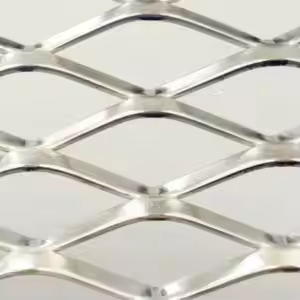
12 gauge wire mesh refers to a grid-like material constructed from wires with a diameter of approximately 0.105 inches (2.67 mm), classified as 12 gauge in the American Wire Gauge (AWG) system. This substantial wire thickness forms a mesh characterized by exceptional tensile strength and resistance to impact, abrasion, and deformation. Available in various mesh patterns—including welded, woven, and expanded—our 12 gauge wire mesh is designed to provide reliable, long-term service in critical applications where structural integrity is non-negotiable. Whether you require a rigid barrier for security, a reliable screen for aggregate sorting, or a sturdy reinforcement for concrete, this product category offers a proven solution built to withstand significant stress and environmental challenges.
The following table outlines the standard technical parameters for our core range of welded 12 gauge wire mesh. Custom specifications in woven or expanded patterns are available upon request.
| Specification | Detail / Measurement | Notes |
|---|---|---|
| Wire Gauge (Diameter) | 12 AWG (0.105 in / 2.67 mm) | Primary determinant of strength and weight. |
| Common Mesh Opening Sizes | 1" x 1", 2" x 2", 4" x 4", 1/2" x 1/2" | Other rectangular or square openings can be manufactured. |
| Standard Panel Sizes | 4' x 8', 4' x 10', 5' x 10', or custom rolls/lengths | Designed to minimize waste and simplify installation. |
| Available Materials | Mild Steel, Stainless Steel 304 & 316, Galvanized Steel, PVC-Coated | Material selection depends on environmental and corrosion-resistance needs. |
| Welding Type | Resistance Welded at Every Intersection | Ensures a uniform, high-strength bond across the entire panel. |
| Finish / Treatment | Mill, Galvanized (Before or After Welding), Powder-Coated, PVC Dipped | Finishes enhance appearance and provide additional corrosion protection. |
| Primary Applications | Security Fencing, Machine Guards, Heavy Screening, Partitions, Reinforcement | See Application Scenarios for detailed use cases. |
The robustness of 12 gauge wire mesh makes it indispensable in a wide array of industrial and commercial settings. Its primary function is to provide a secure, permeable barrier that combines protection with visibility and airflow.
Within factories and plants, this mesh is used to construct durable machine guards, safety barriers around hazardous equipment, and protective screens for welding stations. Its strength prevents tools or debris from penetrating, while the open design allows for ventilation and observation. It is also employed in heavy-duty material handling as screen decks for large aggregate or mining operations.
For high-security facilities like correctional institutions, power plants, and storage yards, 12 gauge wire mesh forms the core of formidable perimeter fencing and anti-climb screens. When fabricated into panels, its rigidity and resistance to cutting provide a significant deterrent against intrusion, far exceeding the performance of lighter gauge alternatives.
In construction, it serves as a reliable reinforcement for concrete in demanding applications such as industrial floors, foundations, and retaining walls. It is also used to create sturdy partitions, mezzanine decking, and debris containment screens on large-scale building sites.
The agricultural sector utilizes this heavy-duty mesh for constructing animal pens, cages for large livestock, predator-proof enclosures, and durable fencing for pastures. Galvanized or coated versions offer excellent resistance to the corrosive effects of animal waste and outdoor exposure.
Beyond pure function, 12 gauge wire mesh finds use in architectural applications for decorative screens, balcony infill panels, and modern façade elements. When specified in stainless steel or with a colored coating, it provides a contemporary aesthetic while maintaining its protective qualities.
Choosing a 12 gauge wire mesh over lighter options (such as 14, 16, or 18 gauge) is a strategic decision based on long-term performance and total cost of ownership.
Selecting the right supplier is as critical as selecting the right product specification. We distinguish ourselves through a commitment to quality, service, and expertise that supports your project's success.
A: The weight varies based on the mesh opening size and material. For example, a 12 gauge welded wire mesh with a 1" x 1" opening in mild steel weighs approximately 2.5 lbs per square foot. We provide exact weight calculations with every quotation to aid in structural planning and shipping estimates.
A: Yes, it is an excellent choice for outdoor fencing. To prevent rust, we strongly recommend specifying a galvanized finish (either before or after welding) or a PVC/polyester coating. For highly corrosive environments (coastal or chemical exposure), stainless steel 12 gauge wire mesh, particularly Type 316, offers the highest level of corrosion resistance.
A: Welded mesh has wires fused together at each intersection, creating a rigid, fixed-aperture panel ideal for screens, guards, and partitions. Woven mesh features wires interlocked in an over-and-under pattern, offering more flexibility, which can be beneficial for filtering or wrapping applications. The choice depends on the required rigidity and function.
A: While the 12 gauge wire is thick, we can manufacture mesh with smaller openings, such as 1/2" or even 1/4". It's important to note that as the opening size decreases, the percentage of open area reduces, and the weight per square foot increases significantly. Our technical team can advise on the feasibility and alternatives for fine filtration needs.
A: Lead times depend on the material, finish, and fabrication complexity. For standard specifications from our inventory, we can often ship within 5-7 business days. Custom fabricated panels or large-volume orders typically require 2-4 weeks. We provide a firm production schedule upon order confirmation to align with your project timeline.
PREV:10 10 wire mesh
Strategic Custom Metal Fabrication Services

Understanding 300 Mesh Stainless Steel Screen Applications and Performance

Understanding 304 Stainless Steel Mesh Screen for Industrial Applications

Understanding 12 mesh stainless steel screen Applications and Technical Details
Understanding the Versatility of 10 mesh stainless steel screen Applications
Ready to move your project from technical blueprint to precision reality? Whether you require large-scale CNC machining, complex structural assembly, or specialized fabrication with rare alloys like Titanium and Nickel, our engineering team is prepared to assist. At metalfabricationcn.com, we solve the manufacturing challenges that others find too large or too complex. Reach out today to discuss your specific requirements, and let us help you optimize your supply chain with ISO 9001 certified reliability.