
Understanding 300 Mesh Stainless Steel Screen Applications and Performance

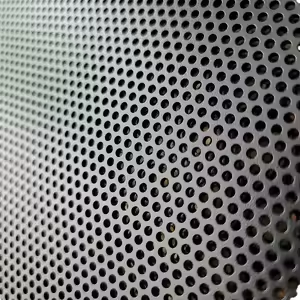
For modern poultry farmers and commercial operations, the foundation of a healthy, productive, and manageable flock starts from the ground up. The wire mesh chicken coop floor represents a significant advancement over traditional solid flooring systems, offering unparalleled benefits in hygiene, waste management, and animal welfare. Engineered for durability and efficiency, our heavy-duty welded wire mesh panels are specifically designed to withstand the demanding environment of poultry housing, providing a clean, dry, and well-ventilated living space for chickens, quails, ducks, and other poultry. This investment-grade flooring solution is crafted to reduce labor costs, minimize disease risk, and improve overall farm profitability, making it an essential component for forward-thinking agricultural businesses worldwide.
Our wire mesh chicken coop floor is a precision-manufactured system comprised of high-tensile steel wire, welded at every intersection to form a rigid, load-bearing panel. Unlike flimsy netting or woven mesh, this robust construction ensures the floor remains flat and stable under the constant weight and activity of poultry. The open grid design is the core of its functionality; it allows manure and waste to fall through the openings, separating the birds from their droppings. This fundamental principle drastically reduces ammonia levels, limits parasite and pathogen proliferation, and keeps the birds' feet and feathers cleaner. Available in a range of gauges, mesh sizes, and surface treatments, our flooring can be customized to suit everything from small-scale layer houses to large-scale broiler production facilities, ensuring optimal performance for every application.
| Parameter | Specification Options | Description / Benefit |
|---|---|---|
| Wire Gauge (Diameter) | 8 Gauge (4.0mm), 10 Gauge (3.5mm), 12 Gauge (2.7mm) | Determines strength and load capacity. Heavier gauges (lower number) are for larger birds or high-traffic areas. |
| Mesh Size (Hole Opening) | 1" x 1" (25mm x 25mm), 1" x 1/2", 2" x 1" | Balances manure passage with foot comfort. Smaller openings provide better support for smaller birds like chicks or quail. |
| Panel Dimensions | Customizable; Standard: 3ft x 6ft, 4ft x 8ft, 1m x 2m | Designed for easy handling and installation. Custom sizes minimize cutting and waste on-site. |
| Material & Finish | Hot-Dip Galvanized (HDG), Electro-Galvanized (EG), PVC Coated (Green, Blue, etc.) | HDG offers the highest corrosion resistance. PVC coating adds an extra protective layer and can be color-coded. |
| Welding Type | Fully Electric Resistance Welded | Ensures a rigid, non-shift connection at every wire intersection, preventing unraveling and maintaining panel integrity. |
| Edge Detail | Raw Cut, Hemmed Edge, Reinforced Border Wire | Reinforced borders provide extra safety and prevent snagging, creating a more finished and durable product. |
| Load Capacity | Varies by specification; typically exceeds 250 lbs/sq ft | Engineered to safely support the dynamic load of moving poultry flocks and necessary farm equipment. |
The versatility of a well-constructed wire mesh chicken coop floor makes it suitable for a broad spectrum of poultry farming operations. In commercial egg production (layer houses), the flooring is instrumental in maintaining hen health and egg cleanliness, directly impacting product quality and food safety standards. For broiler chicken production, the dry environment helps prevent breast blisters and leg issues, promoting faster, healthier growth rates. The system is equally effective in pullet rearing facilities, breeder houses, and for other poultry such as ducks, turkeys, and quails, with mesh size adjusted accordingly. Beyond the main housing, these mesh panels are ideal for raised aviary systems, cleaning and sorting stations, and as durable flooring for transport cages or temporary holding pens. Its modular nature allows for integration into both new construction projects and retrofits of existing barns.
Transitioning to a wire mesh chicken coop floor system delivers tangible, measurable advantages that impact the bottom line. Compared to deep litter or solid concrete floors, the primary benefit is a drastic reduction in disease incidence. By separating birds from manure, the cycle of coccidiosis, worm infestations, and bacterial diseases is interrupted. This leads to lower mortality rates and reduced veterinary and medication costs. The improved hygiene also enhances feed conversion ratios (FCR), as birds are healthier and expend less energy fighting illness. From a labor perspective, the time and cost associated with frequent litter changes, scraping, and deep cleaning are minimized. Furthermore, the collected manure underneath is drier and easier to handle, often commanding a higher value as compost or fertilizer. The durability of steel mesh means this is a long-term capital investment with a lifespan that far exceeds that of wooden slats or plastic alternatives, providing superior return on investment (ROI) over time.
As a leading manufacturer and supplier in the agricultural infrastructure sector, we distinguish ourselves through uncompromising quality, technical expertise, and client-focused service. Our wire mesh chicken coop floor is not a generic commodity; it is a purpose-engineered product. We utilize state-of-the-art welding technology and stringent quality control at every production stage to ensure consistent panel strength and dimensional accuracy. Our in-house engineering team can provide technical support and customization, advising on the optimal gauge, mesh size, and finish for your specific bird type, climate, and housing design. We understand the critical nature of supply chains in farming, which is why we maintain reliable stock and offer flexible logistics solutions for container loads or LTL shipments globally. When you partner with us, you are not just purchasing flooring—you are investing in a partnership dedicated to the productivity and sustainability of your poultry operation.
For standard laying hens, a mesh opening of 1" x 1" (25mm x 25mm) or 1" x 1/2" is typically ideal. This size provides excellent manure passage while offering secure and comfortable footing, preventing foot injuries and ensuring good support.
When designed correctly, a wire mesh chicken coop floor is very foot-friendly. The key is using an appropriate wire gauge and mesh size. The wires are thick enough to provide a flat bearing surface, and the openings are small enough to prevent toes from getting caught. Proper installation on a level support frame is also crucial to avoid pressure points.
The mesh panels are installed onto a framework of galvanized steel joists or purlins, typically spaced 24 to 36 inches apart depending on the wire gauge and expected load. The panels are then securely fastened using clips, ties, or bolts. We provide detailed installation guidelines and can advise on support structure specifications.
Hot-dip galvanizing (HDG) involves dipping the welded mesh in molten zinc, providing a thick, durable coating that offers superior rust protection, making it the best choice for highly corrosive environments. PVC coating applies a layer of plastic over a galvanized base, adding extra corrosion resistance, cushioning, and color options. The choice depends on your budget, environmental conditions, and specific needs.
Yes, but with modifications. For very young chicks or small birds like quail, a smaller mesh size (e.g., 1/2" x 1/2") is required. It is also common practice to cover the wire mesh chicken coop floor with a solid removable board or paper for the first 7-10 days to provide a uniform surface and prevent drafts, removing it once the chicks are larger.
Beneath the raised mesh floor, a manure pit or belt system is installed. Deep pits allow for less frequent cleaning (e.g., between flocks), while conveyor belt systems remove manure daily. The dry, separated nature of the manure due to the mesh makes both collection and subsequent composting or disposal more efficient and less labor-intensive.
PREV:wire mesh belts
Understanding 300 Mesh Stainless Steel Screen Applications and Performance

Detailed Analysis of 2mm Stainless Steel Mesh Properties and Applications

Understanding 304 Stainless Steel Mesh Screen for Industrial Applications
Detailed Analysis of 24 mesh stainless steel screen Applications and Performance

Understanding 30 Mesh Stainless Steel Screen Applications and Material Properties
Ready to move your project from technical blueprint to precision reality? Whether you require large-scale CNC machining, complex structural assembly, or specialized fabrication with rare alloys like Titanium and Nickel, our engineering team is prepared to assist. At metalfabricationcn.com, we solve the manufacturing challenges that others find too large or too complex. Reach out today to discuss your specific requirements, and let us help you optimize your supply chain with ISO 9001 certified reliability.