
Apr . 01, 2024 17:55 Back to list
Air Pressure Gauge how to use air pressure gauge Performance Analysis
Introduction
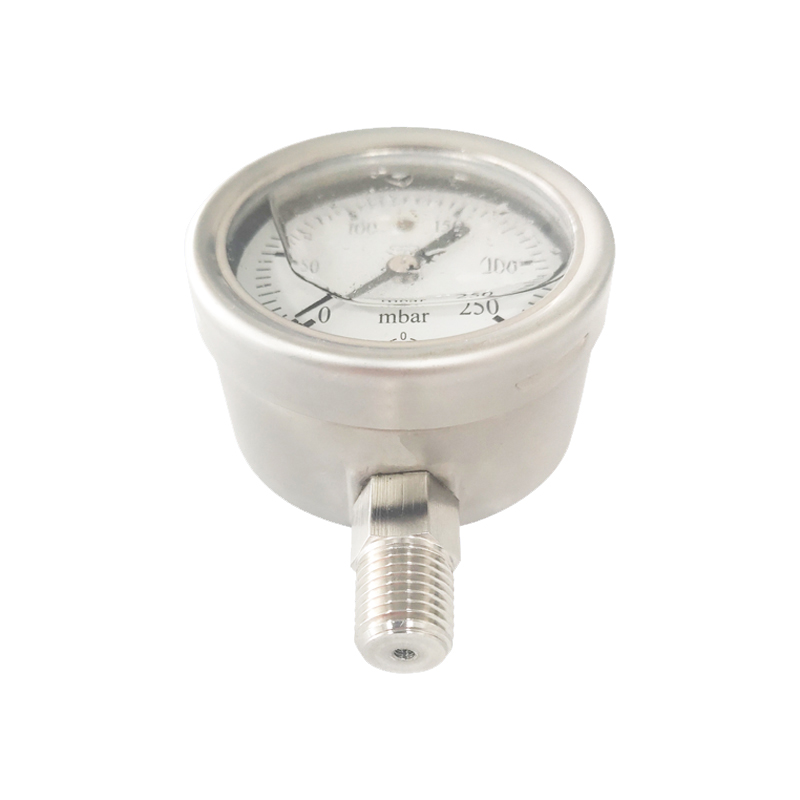
Air pressure gauges are critical instruments used to measure the pressure of gases within a system. They are ubiquitous across diverse industries, including pneumatic systems, HVAC, automotive, aerospace, and process control. This guide provides an in-depth technical overview of air pressure gauge functionality, material science, operational considerations, failure modes, and maintenance procedures. Understanding these aspects is crucial for ensuring accurate readings, optimizing system performance, minimizing downtime, and maintaining workplace safety. The core performance characteristic of an air pressure gauge lies in its ability to accurately translate pressure into a readable format, typically PSI, Bar, kPa, or MPa, while maintaining linearity, hysteresis, and repeatability within specified tolerances. The selection of a gauge hinges on the application's pressure range, media compatibility, and required accuracy.
Material Science & Manufacturing
The construction of air pressure gauges typically involves a combination of materials chosen for their strength, corrosion resistance, and compatibility with the measured media. Bourdon tubes, the primary sensing element, are commonly manufactured from beryllium copper alloys (superior elasticity and corrosion resistance), phosphor bronze (good elasticity and moderate corrosion resistance), and stainless steel (high strength, excellent corrosion resistance, suitable for harsh environments). Gauge cases are frequently constructed from steel, aluminum, or thermoplastic materials like ABS or polycarbonate. The dial face is typically made of aluminum or a durable plastic. Manufacturing processes vary based on component. Bourdon tubes are formed through a complex bending and heat-treating process to impart the desired spring characteristics. Cases are often produced through injection molding or stamping. Critical parameter control during manufacturing includes maintaining precise tube dimensions, ensuring consistent heat treatment, and rigorously testing for leaks and structural integrity. Welding processes used, particularly in stainless steel construction, require controlled shielding gas mixtures to prevent oxidation and maintain mechanical properties. Surface treatments like passivation are commonly applied to stainless steel to enhance corrosion resistance. The choice of gasket material (e.g., nitrile, Viton, Teflon) is paramount for media compatibility and preventing leaks.
Performance & Engineering
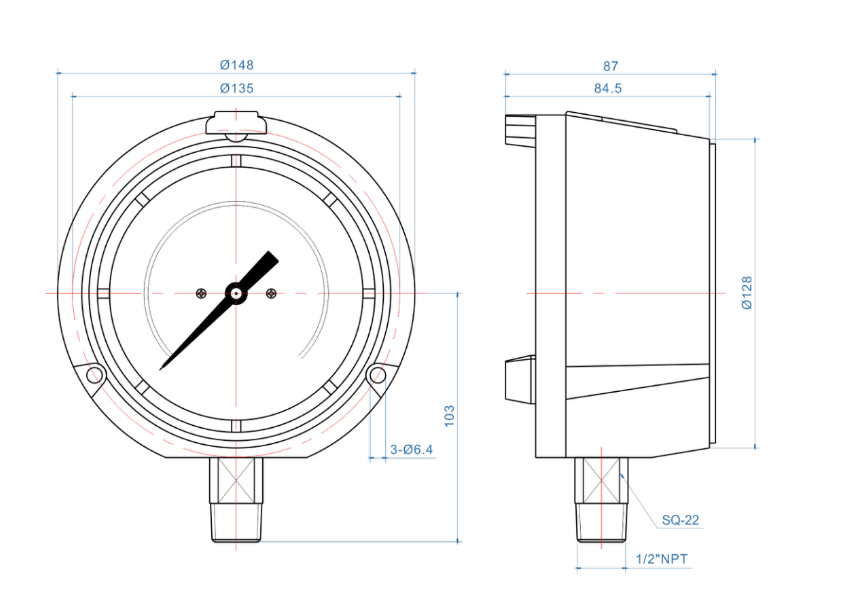
The engineering principles behind air pressure gauge operation are rooted in the principles of elasticity and force transmission. The Bourdon tube, a curved, flattened tube, deflects proportionally to the pressure applied internally. This deflection is mechanically linked to a gear and pinion mechanism, which drives the pointer across the calibrated dial. Force analysis involves understanding the stresses induced within the Bourdon tube under pressure and ensuring the material's yield strength is not exceeded. Environmental resistance is a crucial consideration. Gauges are often designed to withstand vibration, shock, and temperature fluctuations. Liquid-filled gauges (glycerin or silicone oil) are employed in applications with high vibration to dampen pointer oscillation and extend gauge life. Compliance requirements, such as those outlined by ASME B40.100, dictate accuracy classes and testing procedures. Functional implementation includes considerations for mounting orientation (vertical, horizontal, panel mount) and connection type (NPT, BSPT, SAE). Pressure relief devices (backside venting) are incorporated to protect against overpressure events. Hysteresis, the difference in readings between increasing and decreasing pressure, is a critical performance parameter and must be minimized through precise manufacturing and material selection.
Technical Specifications
| Parameter | Typical Range | Accuracy Class (ASME B40.100) | Operating Temperature (°C) |
|---|---|---|---|
| Pressure Range | 0-30 PSI to 0-10,000 PSI | 1.6% FS (Full Scale) to 0.25% FS | -40 to +85 |
| Connection Size | 1/8" NPT, 1/4" NPT, 1/2" NPT | N/A | N/A |
| Case Material | Steel, Aluminum, ABS Plastic | N/A | N/A |
| Wetted Material | Stainless Steel, Beryllium Copper, Phosphor Bronze | N/A | N/A |
| Dial Size | 2", 2.5", 4", 6" | N/A | N/A |
| Overpressure Protection | Typically 125% of Full Scale | N/A | N/A |
Failure Mode & Maintenance
Common failure modes in air pressure gauges include tube rupture (due to overpressure or material fatigue), pointer sticking (caused by friction or contamination within the mechanism), and leakage (resulting from seal degradation or corrosion). Fatigue cracking in the Bourdon tube can occur from repeated pressure cycling, particularly at stress concentration points. Delamination of the dial face can occur due to UV exposure or adhesive failure. Oxidation of internal components can lead to corrosion and inaccurate readings. Maintenance procedures involve regular visual inspection for damage, verification of zero calibration, and periodic testing against a known pressure standard. For liquid-filled gauges, check for fluid leakage and replenish if necessary. Avoid exposing gauges to harsh chemicals or extreme temperatures beyond their specified operating range. If a gauge exhibits erratic readings or visible damage, it should be removed from service and replaced. Periodic cleaning with a mild detergent can help prevent contamination and maintain accuracy. Calibration should be performed annually, or more frequently in critical applications, using a certified pressure calibrator.
Industry FAQ
Q: What is the difference between absolute, gauge, and differential pressure gauges, and which should I use for a pneumatic system?
A: Gauge pressure gauges measure pressure relative to atmospheric pressure, making them ideal for most pneumatic systems where the reference point is ambient air pressure. Absolute pressure gauges measure pressure relative to a perfect vacuum and are used in applications requiring precise absolute pressure measurements, like altitude sensing. Differential pressure gauges measure the difference in pressure between two points and are used for flow measurement or monitoring pressure drops across filters.
Q: How does temperature affect the accuracy of an air pressure gauge?
A: Temperature fluctuations can impact the material properties of the Bourdon tube and the calibration of the mechanism. High temperatures can cause expansion, potentially leading to inaccurate readings. Low temperatures can increase material stiffness. Liquid-filled gauges are less susceptible to temperature variations. Consult the gauge's specification sheet for its operating temperature range and accuracy specifications at different temperatures.
Q: What is the significance of the accuracy class specified in ASME B40.100?
A: The accuracy class (e.g., 1.6%, 1.0%, 0.25%) defines the maximum permissible error in the gauge reading as a percentage of the full-scale range. A lower percentage indicates higher accuracy. Selecting the appropriate accuracy class depends on the criticality of the application. For critical control processes, higher accuracy gauges are essential.
Q: Can I calibrate an air pressure gauge myself, or is professional calibration required?
A: While simple zero adjustments can be performed, accurate calibration requires a certified pressure calibrator and a traceable standard. Professional calibration ensures the gauge meets specified accuracy requirements and provides a calibration certificate for documentation purposes. Attempting to calibrate without proper equipment and training can introduce errors and invalidate the gauge’s readings.
Q: What are the advantages of using a digital pressure gauge over an analog gauge?
A: Digital pressure gauges offer several advantages, including higher accuracy, improved readability, digital communication capabilities (e.g., Modbus, 4-20mA), and often, data logging features. They are less susceptible to parallax errors and can provide real-time pressure data to control systems. However, they typically require a power source and may be more expensive than analog gauges.
Conclusion
Air pressure gauges are indispensable components in numerous industrial applications, demanding a thorough understanding of their operational principles, material properties, and potential failure modes. Accurate pressure measurement is paramount for system efficiency, safety, and process control. Proper selection, installation, maintenance, and periodic calibration are crucial to ensure reliable performance and longevity. The evolution of pressure gauge technology continues with the increasing adoption of digital gauges offering enhanced features and improved accuracy.
Continued advancements in material science, particularly in alloy development and sensor technology, will lead to more robust and precise air pressure gauges capable of withstanding increasingly demanding operating conditions. Future trends include the integration of wireless communication capabilities for remote monitoring and predictive maintenance, further enhancing the value and reliability of these critical instruments.
 English
  Arabic
  China
China  China (Taiwan)
  Danish
  Dutch
Dutch  French
  German
  Greek
Greek  Hindi
Hindi  Indonesian
  Italian
  Japanese
  Korean
  Latin
Latin  Polish
  Portuguese
  Russian
  Spanish
  Turkish