Introduction
Automotive jack stands are essential safety devices used in conjunction with automotive jacks to support vehicles during maintenance and repair operations. Unlike jacks, which are designed for lifting, jack stands are engineered to securely hold a lifted vehicle’s weight, mitigating the risk of collapse during work. This technical guide provides an in-depth analysis of automotive jack stands, encompassing material science, manufacturing processes, performance engineering, failure modes, maintenance procedures, and relevant industry standards. Their correct selection and application are critical for worker safety and preventing vehicle damage. The market features a wide range of stands, categorized by load capacity, height adjustment mechanisms, and construction materials, necessitating a thorough understanding of these parameters for appropriate application. This guide will focus on heavy-duty steel jack stands typically used in professional automotive repair facilities.
Material Science & Manufacturing
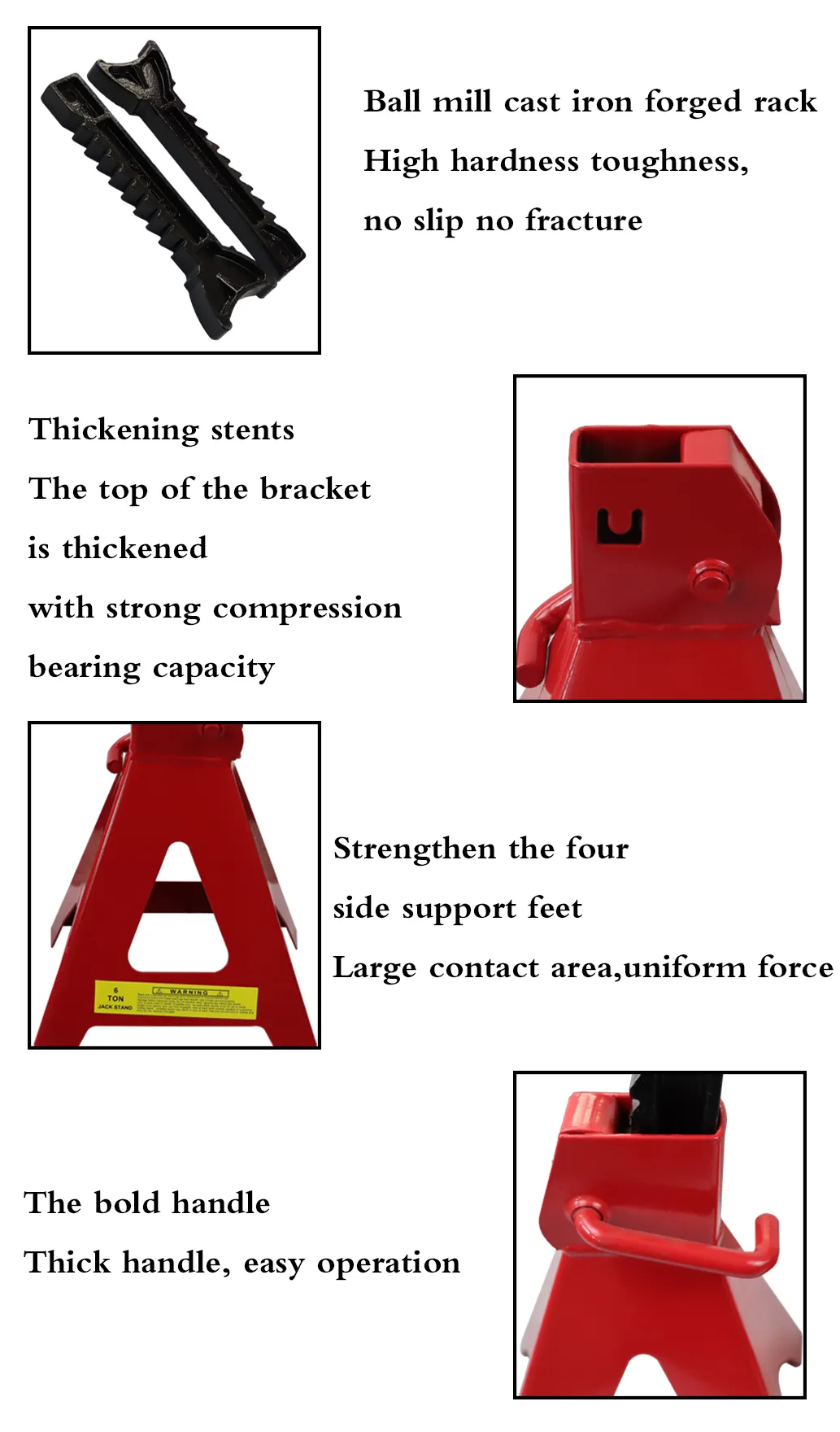
The primary material for automotive jack stands is typically carbon steel, specifically AISI 1018 or equivalent, chosen for its balance of strength, weldability, and cost-effectiveness. Higher-capacity stands may utilize higher grade steels such as AISI 4140 for increased tensile strength and yield strength. Manufacturing begins with steel plate or tubing, which undergoes precision cutting and forming operations – typically involving CNC laser cutting, hydraulic pressing, and roll forming – to create the stand's structural components: the base, upright post, and saddle. Critical welds, often performed using Gas Metal Arc Welding (GMAW) or Flux-Cored Arc Welding (FCAW), are subjected to non-destructive testing, including visual inspection and, increasingly, ultrasonic testing, to ensure structural integrity. The ratchet mechanism, responsible for height adjustment, frequently utilizes hardened steel pawls and gears, often case-hardened to improve wear resistance. Surface treatments are crucial for corrosion protection. Common methods include phosphate coating (for improved paint adhesion) followed by powder coating with a durable epoxy or polyurethane finish. The quality of the powder coating, measured by its thickness and salt spray resistance, directly impacts the stand's longevity in corrosive environments. The saddle, the contact point with the vehicle, is often coated with a high-density polyethylene (HDPE) or similar polymer to prevent damage to the vehicle’s frame and provide a non-slip surface.
Performance & Engineering
The engineering of automotive jack stands centers on providing a stable and reliable support system under static and dynamic loads. Force analysis is paramount, considering the vehicle’s weight distribution and potential for shifting during work. The base geometry is designed to maximize stability, with a wide footprint and low center of gravity. Finite Element Analysis (FEA) is commonly employed during the design phase to identify stress concentration points and optimize material thickness and weld placement. The ratchet mechanism is engineered to withstand repeated engagement and disengagement cycles without failure. Its locking strength is a critical performance parameter, dictated by the geometry of the pawl and gear teeth, as well as the spring force applied to the pawl. Environmental resistance is another key consideration. Jack stands are frequently exposed to moisture, road salt, and automotive fluids. Therefore, corrosion protection is vital. The design must also account for potential deformation under prolonged loading. Creep, the tendency of a solid material to move slowly or permanently deform under the stress, is a critical factor in long-term performance. Compliance requirements, such as those specified by ANSI/ASSP standards, dictate minimum load capacities and stability criteria. Standards typically require a static load test to 125% of the rated capacity and a dynamic load test to simulate vehicle movement.
Technical Specifications
| Load Capacity (per stand) | Minimum Height | Maximum Height | Base Width |
|---|---|---|---|
| 3 Ton (6,000 lbs / 2722 kg) | 11 in (279 mm) | 18 in (457 mm) | 26 in (660 mm) |
| 6 Ton (12,000 lbs / 5443 kg) | 14 in (356 mm) | 24 in (610 mm) | 32 in (813 mm) |
| 10 Ton (20,000 lbs / 9072 kg) | 16 in (406 mm) | 30 in (762 mm) | 38 in (965 mm) |
| Steel Grade (Upright Post) | Steel Grade (Base) | Ratchet Mechanism Type | Coating Type |
| AISI 1018 | AISI 1018 | Pawl and Gear | Powder Coat Epoxy |
| AISI 4140 (Heavy Duty) | AISI 1018 | Dual Ratchet | Powder Coat Polyurethane |
Failure Mode & Maintenance
Automotive jack stands are susceptible to several failure modes. Yielding or fracture of the upright post due to overloading is a primary concern. Fatigue cracking can occur in the weld joints connecting the base, post, and saddle, particularly under repeated loading and unloading. Ratchet mechanism failure, resulting from worn pawl teeth or a broken spring, can cause the stand to collapse unexpectedly. Corrosion, especially in areas exposed to moisture and road salt, weakens the steel structure and accelerates fatigue cracking. Deformation of the base due to uneven loading or soft ground can compromise stability. Maintenance is crucial for preventing failures. Regularly inspect stands for signs of corrosion, cracks, and weld defects. Lubricate the ratchet mechanism with a light oil to ensure smooth operation. Avoid exceeding the rated load capacity. Always use jack stands on a level, hard surface. Do not attempt to repair damaged jack stands; replace them immediately. Periodically check the integrity of the powder coating and re-coat if necessary to maintain corrosion protection. A thorough visual inspection prior to each use is paramount.
Industry FAQ
Q: What is the appropriate safety factor for jack stand load capacity?
A: Industry standards typically require a safety factor of at least 2:1. This means the jack stand should be able to withstand at least twice its rated load capacity without failure. However, it is best practice to choose stands with a higher safety factor for added security, especially when working with heavier vehicles.
Q: How often should jack stands be inspected?
A: Jack stands should be visually inspected before every use. A more thorough inspection, including checking for corrosion, cracks, and weld defects, should be performed at least annually, or more frequently if the stands are subjected to heavy use or harsh environmental conditions.
Q: Can jack stands be used on uneven surfaces?
A: No. Jack stands must be used on a level, hard surface. Uneven surfaces can compromise stability and significantly increase the risk of collapse. If a level surface is not available, use wood shims or other suitable leveling devices to create a stable base.
Q: What is the difference between a single-pin and a dual-pin jack stand?
A: Dual-pin jack stands offer increased stability and a wider range of height adjustments compared to single-pin stands. They typically have two locking pins in the ratchet mechanism, providing redundancy and preventing the stand from collapsing if one pin fails. Dual-pin stands are generally preferred for heavier vehicles and more demanding applications.
Q: What type of steel is best for jack stand construction?
A: While AISI 1018 is common due to cost-effectiveness, AISI 4140 or equivalent alloy steels offer superior strength and durability, especially for high-capacity jack stands. The ideal steel choice depends on the intended load capacity and application. Properly heat-treated carbon steel is more critical than the specific alloy.
Conclusion
Automotive jack stands, despite their seemingly simple design, are critical safety components demanding careful consideration of material science, manufacturing quality, and performance engineering. The selection of appropriate stands, based on vehicle weight and anticipated workload, is paramount for preventing catastrophic failures. Consistent inspection and proper maintenance are non-negotiable aspects of ensuring continued operational safety and extending the service life of these essential tools.
Looking forward, advancements in materials technology and manufacturing processes will likely lead to lighter, stronger, and more durable jack stands. Innovations in locking mechanisms and base designs will continue to improve stability and ease of use. Adherence to stringent industry standards, such as those developed by ANSI/ASSP, is crucial for ensuring the continued safety and reliability of these vital automotive repair tools.
