Introduction
Tool trolleys, specifically those finished in black powder coat, represent a crucial component in modern industrial and workshop organization. Positioned within the material handling equipment sector, their primary function is the efficient and secure transport of tools and equipment. These trolleys are utilized across a broad spectrum of industries including manufacturing, automotive repair, aerospace maintenance, and construction. Core performance characteristics are defined by load capacity, durability, maneuverability, and the organization features provided – drawer configurations, tray depths, and overall structural integrity. Increasingly, tool trolleys are being designed with specific ESD (Electrostatic Discharge) compliance for sensitive electronics environments, adding another layer of technical complexity and performance requirement. The prevalence of modular designs further enhances their adaptability to diverse user needs, making them a staple in lean manufacturing principles and 5S workplace methodologies. A key pain point in the industry revolves around balancing cost with durability; inexpensive trolleys often exhibit premature failure through weld degradation or inadequate material gauge, leading to increased lifecycle costs.
Material Science & Manufacturing
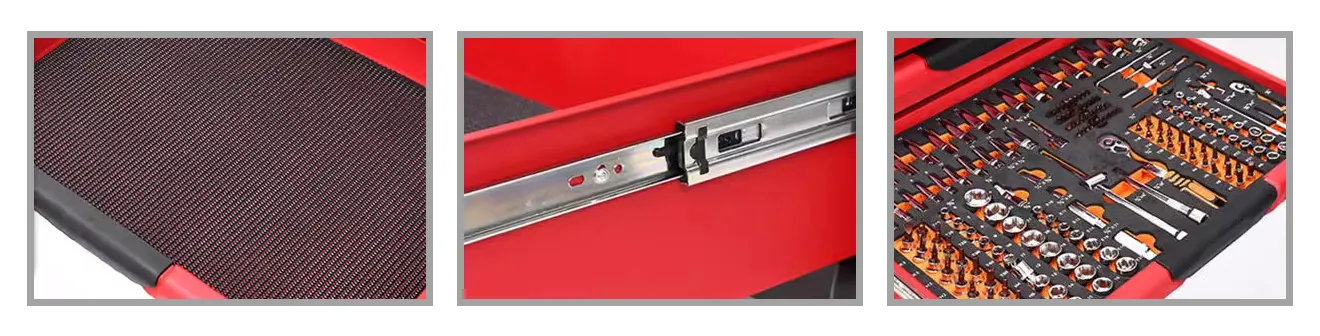
The construction of a typical tool trolley black predominantly utilizes cold-rolled steel, selected for its balance of strength, formability, and cost-effectiveness. Steel grades commonly employed include SPCC (Steel Plate Cold Commercial) and DC01, with thickness ranging from 1.2mm to 2.0mm depending on load-bearing requirements. The black finish is typically achieved through a multi-stage process: pre-treatment involving degreasing and phosphating to enhance adhesion, followed by electrostatic powder coating using a polyester-based powder. Polyester provides excellent chemical resistance, UV stability, and impact strength. Drawer slides are commonly constructed from DC53 high-carbon steel for hardness and wear resistance, often with zinc plating for corrosion protection. Casters utilize a combination of materials: the core is typically polypropylene for impact resistance, the bearing is sealed ball bearing steel (typically 608ZZ), and the wheel tread can be polyurethane or natural rubber for varying levels of grip and floor protection. Manufacturing processes include laser cutting for component shaping, robotic welding (MIG/MAG) for structural assembly, and automated powder coating lines for finish application. Critical parameter control during welding focuses on maintaining consistent penetration depth and minimizing heat-affected zones to prevent material distortion and weld cracking. Powder coating thickness must be precisely controlled (typically 60-80 microns) to ensure adequate corrosion resistance and aesthetic uniformity.
Performance & Engineering
Performance of a tool trolley is governed by a combination of static and dynamic load analysis. Static load capacity refers to the maximum weight the trolley can support when stationary, while dynamic load capacity considers the stresses induced during movement, including acceleration, deceleration, and uneven floor surfaces. Finite Element Analysis (FEA) is often employed during the design phase to optimize structural components and identify potential stress concentration points. Stability is a critical engineering concern, particularly with taller trolleys; a wider wheelbase and lower center of gravity improve resistance to tipping. Caster selection directly impacts maneuverability and load distribution. Swivel casters provide greater agility, while fixed casters offer higher load capacity. Bearing preload is a key parameter, influencing both rolling resistance and caster life. Environmental resistance is paramount; the powder coating must withstand exposure to common workshop chemicals such as oils, solvents, and cleaning agents. Compliance requirements vary by region, but often include standards relating to caster braking performance (ensuring the trolley remains stationary on slopes) and material safety (RoHS compliance restricting hazardous substances). The drawer locking mechanisms must reliably secure tools during transport, preventing accidental spillage. Force analysis on drawer slides considers both tensile and shear forces experienced during extension and retraction, dictating slide material selection and mounting hardware strength.
Technical Specifications
| Parameter | Unit | Typical Value (Standard Trolley) | High-Duty Trolley |
|---|---|---|---|
| Overall Dimensions (L x W x H) | mm | 780 x 460 x 900 | 1200 x 550 x 1050 |
| Maximum Load Capacity | kg | 150 | 300 |
| Number of Drawers | - | 5 | 7 |
| Drawer Load Capacity (per drawer) | kg | 20 | 30 |
| Material (Frame) | - | SPCC Cold-Rolled Steel (1.5mm) | SPCC Cold-Rolled Steel (2.0mm) |
| Finish | - | Black Polyester Powder Coat (60-80 μm) | Black Polyester Powder Coat (80-100 μm) |
Failure Mode & Maintenance
Common failure modes for tool trolleys include caster failure (bearing seizure, wheel cracking, stem breakage), drawer slide malfunction (binding, premature wear, complete failure), weld cracking (particularly at high-stress joints), and powder coat chipping/corrosion. Fatigue cracking can occur in the frame under repeated loading and unloading cycles. Drawer slides are susceptible to contamination from metal filings and debris, accelerating wear. Weld cracking is often initiated at the weld toe due to stress concentration. Corrosion can develop in areas where the powder coat is damaged, especially in humid environments. Maintenance involves regular inspection of casters for smooth rolling and secure mounting, lubrication of drawer slides with silicone-based lubricants, tightening of loose fasteners, and touch-up of damaged powder coat to prevent corrosion. Preventative maintenance schedules should include periodic checks of weld integrity (visual inspection for cracks) and load capacity adherence. If caster replacement is necessary, ensure the new casters have equivalent load ratings and mounting dimensions. Addressing minor powder coat damage promptly prevents the spread of corrosion and extends the trolley’s lifespan. Periodic cleaning with mild detergent and water removes contaminants that accelerate wear and corrosion.
Industry FAQ
Q: What is the typical lifespan expectation for a professionally used tool trolley?
A: The lifespan varies significantly based on load, frequency of use, and maintenance. A standard trolley, with proper maintenance, can be expected to last 5-7 years in a moderately demanding environment. Higher-duty trolleys with thicker gauge steel and reinforced construction can exceed 10 years. However, neglecting maintenance or consistently exceeding the load capacity will drastically reduce lifespan.
Q: How does ESD compliance affect the construction and cost of a tool trolley?
A: ESD compliance necessitates the use of conductive materials in the frame, drawer construction, and casters. This typically involves specialized powder coatings with conductive additives and the incorporation of grounding points. The cost increases due to these specialized materials and the additional testing required to verify ESD performance to standards like ANSI/ESD S20.20.
Q: What are the key considerations when selecting casters for a tool trolley intended for use on epoxy flooring?
A: Epoxy flooring can be relatively smooth, requiring casters with a high coefficient of friction to prevent unwanted rolling. Polyurethane wheels are generally preferred over hard rubber wheels for epoxy surfaces, providing better grip and minimizing scuffing. Ensure the casters have sealed ball bearings to protect against epoxy dust and debris.
Q: What is the impact of different drawer slide materials (ball bearing vs. roller) on load capacity and smoothness of operation?
A: Ball bearing slides generally offer higher load capacity and smoother operation, but are also more expensive. Roller slides are more robust and can tolerate greater shock loads, but typically have a lower load capacity and may exhibit slightly more friction. The choice depends on the typical weight and handling characteristics of the tools being stored.
Q: What are the typical corrosion resistance standards for tool trolley finishes?
A: Tool trolley finishes are commonly evaluated based on ASTM B117 (Salt Spray Test). A typical polyester powder coat finish should withstand at least 480 hours of salt spray exposure without significant corrosion. Higher performance coatings may achieve 1000+ hours. Compliance with ISO 9227 (Corrosion tests in artificial atmosphere) is also common.
Conclusion
Tool trolley black designs represent a convergence of material science, manufacturing engineering, and ergonomic considerations. Successful implementation requires a thorough understanding of load capacity requirements, environmental conditions, and potential failure modes. Prioritizing high-quality materials, robust construction techniques, and proactive maintenance ensures a long service life and minimizes total cost of ownership. The increasing demand for specialized features, such as ESD compliance and modularity, necessitates a continuous refinement of design and manufacturing processes.
Future development will likely focus on lightweight materials (aluminum alloys and advanced polymers) to further reduce weight and improve maneuverability, as well as integration of smart technologies such as tool tracking and inventory management systems. Further advancements in powder coating technology will continue to improve corrosion resistance and aesthetic appeal. Careful consideration of standardization across different trolley models will improve compatibility with existing workshop infrastructure and streamline the procurement process.
