
Understanding 100 mesh stainless steel screen for Industrial Applications

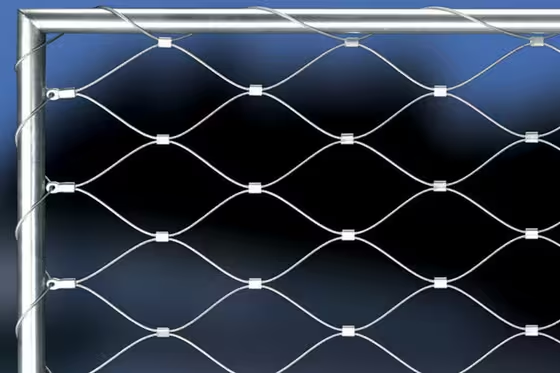
In the demanding world of industrial automation and material processing, the reliability of your conveyor system is paramount. At the core of many drying, cooling, washing, and heat treatment applications lies a critical component: the industrial wire mesh belt. Engineered for durability and precision, our wire mesh belts are designed to withstand extreme temperatures, heavy loads, and corrosive environments, ensuring uninterrupted production flow and superior product handling. As a leading manufacturer with decades of expertise, we provide custom-engineered wire mesh conveyor belts that set the standard for performance and longevity in global industries.
An industrial wire mesh belt is a versatile and robust conveying solution constructed from interlocking metal wires, forming a continuous, flexible, and permeable surface. Unlike solid belt conveyors, the open mesh design allows for free air circulation, liquid drainage, and direct heat transfer, making it indispensable for processes such as food cooking, powder metal sintering, glass tempering, and chemical washing. Our product range encompasses a vast array of weaves—including balanced weave, compound weave, rod-reinforced, and chain-driven designs—each tailored to specific operational requirements. We understand that a one-size-fits-all approach is insufficient for complex industrial challenges. Therefore, we specialize in manufacturing custom wire mesh belts, where every parameter from wire diameter and mesh count to alloy composition and edge configuration is meticulously calculated to optimize your application's efficiency and lifespan.
Our wire mesh belts are manufactured to exacting standards. The table below outlines standard specifications; however, all parameters can be customized to meet your precise application needs.
| Parameter | Specification Range | Notes |
|---|---|---|
| Standard Materials | Stainless Steel 304, 316, 314; Carbon Steel; Galvanized Steel; Inconel | Other alloys available upon request. |
| Wire Diameter | 0.8 mm to 6.0 mm (0.031" to 0.236") | Determines belt flexibility and load capacity. |
| Mesh Size (Opening) | 1.5 x 1.5 mm to 50 x 50 mm (0.06" x 0.06" to 2" x 2") | Custom weaves for very fine or large products. |
| Belt Width | Up to 5000 mm (197") | Wider widths achievable with specific weaves. |
| Operating Temperature | -100°C to 1150°C (-148°F to 2102°F) | Dependent on material selection. |
| Common Weave Types | Balanced, Compound, Rod-Reinforced, Double Weave | Each offers distinct strength and surface characteristics. |
| Edge Type | Knuckled, Welded, Beaded, Chain-Driven | Prevents fraying and provides a positive drive interface. |
The adaptability of the wire mesh conveyor belt makes it a cornerstone across diverse sectors. Its ability to handle thermal stress, mechanical load, and harsh cleaning regimes is unparalleled.
Choosing a wire mesh belt over solid plastic or fabric belts provides distinct operational and economic benefits that directly impact your bottom line.
Selecting the right supplier for your wire mesh conveyor belt is a strategic decision. We differentiate ourselves through deep engineering expertise and an unwavering commitment to partnership.
A: The selection depends on the product's size, weight, and the process requirements (e.g., required open area for airflow or drainage). Our technical team will consult with you to evaluate these factors. As a rule, finer products require smaller mesh and finer wires, while heavy or abrasive loads necessitate larger diameter wires for strength.
A: Lead times vary based on complexity, size, and material availability. Standard custom belts typically ship within 4-6 weeks. For urgent requirements or large projects, we offer expedited manufacturing options. We provide a firm timeline upon finalizing your specification.
A: Yes, we offer comprehensive repair and re-spicing services. In many cases, repairing a section or adding length to an existing belt is a cost-effective alternative to a full replacement. We assess the belt's condition and provide a recommendation.
A: Proper tracking starts with correct specification and installation. Key factors include a level and aligned conveyor frame, correctly tensioned and crowned pulleys, and the appropriate edge design (e.g., guided edges). Our installation manuals and support team provide detailed guidance to prevent tracking issues.
A: Maintenance is generally minimal but crucial. Regular inspection for wear, proper tension, and lubrication of chain-driven edges (if applicable) will extend belt life. We recommend periodic cleaning to remove debris that could accelerate wear or cause corrosion.
A: Absolutely. We manufacture wire mesh belts using FDA-compliant and EU food-grade materials (e.g., AISI 304, 316 stainless steel). Our manufacturing processes are designed to meet the hygiene standards required in food processing environments.
Ready to enhance your production line with a reliable, high-performance conveying solution? Contact our engineering team today for a free consultation and a customized quote for your wire mesh belt requirements. Let us help you build a foundation for seamless, efficient, and profitable operations.
Understanding 100 mesh stainless steel screen for Industrial Applications

Understanding the Versatility of 10 mesh stainless steel screen Applications
Understanding 20 mesh stainless steel screen Applications and Performance

Understanding 1mm Stainless Steel Wire Mesh for Filtration and Industrial Applications
Understanding 300 Mesh Stainless Steel Screen Applications and Performance
Ready to move your project from technical blueprint to precision reality? Whether you require large-scale CNC machining, complex structural assembly, or specialized fabrication with rare alloys like Titanium and Nickel, our engineering team is prepared to assist. At metalfabricationcn.com, we solve the manufacturing challenges that others find too large or too complex. Reach out today to discuss your specific requirements, and let us help you optimize your supply chain with ISO 9001 certified reliability.