
Detailed Analysis of 2mm Stainless Steel Mesh Properties and Applications

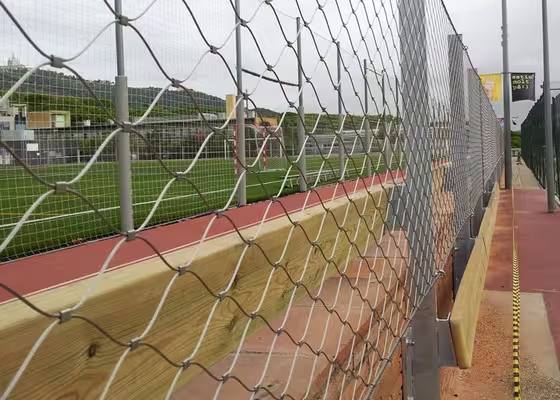
Engineered for superior performance in the most corrosive and high-temperature environments, our wire mesh stainless steel 316 represents the pinnacle of filtration, separation, and protection materials. This austenitic alloy is distinguished by its addition of molybdenum, which dramatically enhances its resistance to pitting and crevice corrosion, particularly from chlorides and industrial solvents. As a global supplier to the processing, chemical, and marine industries, we provide a comprehensive range of weaves, meshes, and specifications in 316 stainless steel wire mesh, ensuring a perfect match for your precise technical requirements. This product is not merely a component; it is a critical investment in the longevity, safety, and efficiency of your operations.
Whether you are screening aggregates, filtering process fluids, safeguarding personnel, or providing reinforcement, our stainless steel 316 wire mesh delivers unmatched durability. We understand that in B2B procurement, consistency and reliability are non-negotiable. Therefore, every roll and sheet of our mesh is manufactured under stringent quality controls, from the sourcing of the raw alloy to the final inspection, guaranteeing you receive a product that performs exactly as specified, batch after batch.
Our wire mesh stainless steel 316 is produced to exacting international standards. The table below outlines our core product range. Custom specifications regarding wire diameter, mesh count, width, and roll length are available upon request for large-volume orders.
| Specification | Details & Range | Standard / Notes |
|---|---|---|
| Alloy Grade | AISI 316 / UNS S31600 / 1.4401 | Certified mill test reports available |
| Primary Composition | Cr 16-18%, Ni 10-14%, Mo 2-3%, C ≤0.08% | Optimal balance for corrosion & strength |
| Weave Types | Plain Weave, Twill Weave, Dutch Weave (Plain & Twilled) | Selection depends on filtration vs. strength needs |
| Mesh Count (per inch/cm) | From 2 x 2 to 500 x 500 | Determines particle retention and flow rate |
| Wire Diameter | 0.025 mm to 3.0 mm (0.001" to 0.125") | Directly influences open area and strength |
| Standard Width | 48" (1220 mm), 60" (1524 mm), 72" (1830 mm) | Custom widths up to 120" possible |
| Roll Length | Standard 100 ft (30.5 m) rolls | Custom cut lengths and sheets available |
| Surface Finish | Standard Mill Finish, Electro-Polished | Electro-polishing enhances cleanability |
The robustness of 316 stainless steel wire mesh makes it the material of choice across a vast spectrum of heavy-duty and precision industries.
Used in catalyst bed supports, filter elements for corrosive acids and solvents, mist eliminators in scrubbers, and safety screens around processing equipment. Its resistance to sulfur compounds and chlorides is paramount.
Essential for seawater intake screens, filtration systems on ships and oil platforms, protective guards on deck machinery, and architectural elements in coastal environments where salt spray is constant.
Food & Beverage Production: Employed in sorting, sizing, and dewatering screens, as well as in safety guards for machinery. Its hygienic properties and ease of cleaning meet stringent FDA and USDA requirements for direct food contact.
Critical in the manufacture of high-purity filters for air, gases, and liquids within cleanrooms, as well as components for sterilization equipment and implantable medical devices.
Used in fuel filtration, cooling water intake screens, and exhaust gas particulate control systems in nuclear, fossil fuel, and waste-to-energy plants.
Provides durable, aesthetically pleasing solutions for balcony infill, façade cladding, security screens, and decorative interior elements, especially in aggressive urban or coastal atmospheres.
Choosing our wire mesh stainless steel 316 provides a clear total cost of ownership advantage compared to lesser alloys or non-metallic alternatives.
In a global market, partnership matters. We differentiate ourselves through technical expertise, reliable supply chains, and unwavering commitment to quality.
A: The key difference is the addition of Molybdenum (Mo) in the 316 alloy. This single element significantly boosts resistance to corrosion from chlorides (like saltwater) and industrial chemicals. For any application involving marine environments, chemical processing, or de-icing salts, 316 stainless steel wire mesh is the necessary and cost-effective choice for long-term performance.
A: Yes, absolutely. AISI 316 wire mesh exhibits excellent weldability using all standard stainless steel welding techniques (TIG, MIG, resistance). We recommend using 316L filler material to maintain optimal corrosion resistance in the weld zone. For critical applications, we can supply mesh with selvage edges to facilitate easier fabrication.
A: The specification depends on the size of the particle you need to retain (micron rating) and the required flow rate. A finer mesh (higher mesh count) traps smaller particles but may reduce flow. Our technical team can assist you in selecting the perfect combination of mesh count and wire diameter. Providing your target micron rating and media viscosity allows us to make a precise recommendation.
A: Yes. Standard shipments include Mill Test Certificates (MTCs) verifying chemical composition and mechanical properties. For project-specific requirements, we can arrange for third-party testing, such as ASTM A262 Practice E (Huey Test) for intergranular corrosion or salt spray testing, at an additional cost and lead time.
A: Lead times vary based on the complexity and volume of the order. For standard weaves and sizes not in stock, typical production lead times are 2-4 weeks. We maintain a stock program for popular specifications of stainless steel 316 wire mesh for expedited shipment. A formal quote will always include a confirmed delivery schedule.
A: While 316 wire mesh performs well at continuous temperatures up to approximately 870°C (1600°F) in intermittent service, prolonged exposure at the upper end of this range can lead to carbide precipitation and reduced corrosion resistance. For constant very high-temperature applications (e.g., furnace curtains), we may recommend a higher-grade alloy like 314 or 310. Consult our engineers for specific temperature and atmosphere details.
PREV:screening wire mesh
NEXT:wire mesh belt
Detailed Analysis of 2mm Stainless Steel Mesh Properties and Applications

Detailed Analysis of 24 mesh stainless steel screen Applications and Performance

Understanding 100 mesh stainless steel screen for Industrial Applications

Understanding 304 Stainless Steel Mesh Screen for Industrial Applications
Comprehensive Guide to Durable 316 Stainless Steel Security Screens
Ready to move your project from technical blueprint to precision reality? Whether you require large-scale CNC machining, complex structural assembly, or specialized fabrication with rare alloys like Titanium and Nickel, our engineering team is prepared to assist. At metalfabricationcn.com, we solve the manufacturing challenges that others find too large or too complex. Reach out today to discuss your specific requirements, and let us help you optimize your supply chain with ISO 9001 certified reliability.