
Detailed Analysis of 2mm Stainless Steel Mesh Properties and Applications

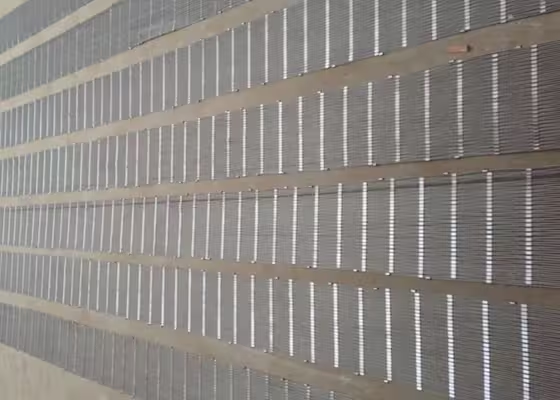
In the realm of structural integrity and durable construction, concrete welded wire mesh stands as a fundamental and indispensable material. This high-strength steel reinforcement, composed of a grid of longitudinal and transverse wires welded at their intersections, is engineered to provide superior crack control, load distribution, and tensile strength to concrete slabs and structures. As a leading supplier in the global construction materials market, we provide premium-grade welded wire fabric that meets and exceeds international standards, ensuring your projects are built on a foundation of reliability and performance. This product page details everything B2B buyers, contractors, and engineers need to know about specifying and sourcing the right concrete welded wire mesh for their applications.
Concrete welded wire mesh, often referred to as WWF or WWM, is a factory-manufactured reinforcement material created by electrically welding steel wires together at precise right angles. This process creates a rigid, uniform grid that is delivered to construction sites in sheets or rolls, ready for installation. Its primary function is to act as a secondary reinforcement in concrete, effectively holding the material together as it cures and bears loads, thereby mitigating shrinkage cracks and enhancing the slab's overall structural capacity. Unlike loose rebar, which requires extensive tying on-site, welded wire mesh offers significant time and labor savings due to its prefabricated nature. It is a versatile solution used globally in a vast array of residential, commercial, industrial, and civil engineering projects, from simple pavement to complex foundational works. The consistent quality and dimensional accuracy of machine-welded mesh ensure predictable performance, a critical factor for engineers designing to specific load-bearing requirements.
Our concrete welded wire mesh is produced in compliance with major international standards such as ASTM A185/A185M, ASTM A497/A497M, BS 4483, and AS/NZS 4671. We offer a comprehensive range of sizes and styles to meet diverse project demands. Below is a detailed specification table for our most common product lines.
| Mesh Designation | Longitudinal Wire Spacing (mm) | Transverse Wire Spacing (mm) | Wire Diameter (mm) | Cross-Sectional Area (mm²/m) | Standard Sheet Size (m) | Primary Application |
|---|---|---|---|---|---|---|
| A142 | 200 | 200 | 6.0 | 142 | 2.4 x 6.0 / 4.8 x 2.4 | Light duty slabs, paths, non-structural fill |
| A193 | 200 | 200 | 7.0 | 193 | 2.4 x 6.0 / 4.8 x 2.4 | Domestic floor slabs, paving |
| A252 | 200 | 200 | 8.0 | 252 | 2.4 x 6.0 / 4.8 x 2.4 | Heavier duty floors, raft foundations |
| A393 | 200 | 200 | 10.0 | 393 | 2.4 x 6.0 / 4.8 x 2.4 | Heavy industrial floors, hardstanding |
| D49 / D98 (Square Mesh) | 100 / 200 | 100 / 200 | 2.5 - 6.0 | Varies | Rolls or Sheets | Thin section concrete, cladding, fencing |
| Structural Fabric (Heavy) | 100 - 150 | 100 - 150 | 12.0 - 16.0 | 500 - 1500+ | Custom | Bridge decks, pile caps, bunkers |
Note: Custom specifications, including sheet/roll dimensions, wire grades (e.g., 500 MPa tensile strength), and special coatings, can be manufactured to order. Contact our technical team with your project drawings for a tailored quotation.
The versatility of concrete welded wire mesh makes it a critical component across the construction spectrum. Its primary role is to reinforce concrete against tensile forces, which concrete alone cannot withstand effectively.
Choosing concrete welded wire mesh over alternative reinforcement methods delivers tangible benefits to project timelines, budgets, and final quality.
In a competitive global market, partnering with a reliable and expert supplier is paramount. We distinguish ourselves through an unwavering commitment to quality, service, and client success.
A: While both reinforce concrete, rebar consists of individual steel bars that are cut, bent, and tied together on-site to form a grid. Concrete welded wire mesh is a prefabricated grid of wires welded together. WWM is generally more efficient for slab reinforcement where wires are closely spaced, offering faster installation and excellent crack control. Rebar is typically used for heavier structural elements like columns, beams, and foundations where larger diameters and specific bending configurations are required.
A: For ground-supported slabs, the concrete welded wire mesh should be positioned in the upper third of the slab thickness, typically 2-3 inches below the surface. This is because the top of the slab is in tension when loaded. It must be adequately supported on "chairs" or "dobies" during the pour to prevent it from sinking to the bottom.
A: Yes, sheets must be overlapped to ensure continuity of reinforcement. The standard minimum lap length is typically one mesh spacing plus 50mm, or as specified by the project engineer (e.g., 300mm). Wires should be overlapped and, where possible, tied together at intervals to maintain alignment.
A: Galvanized concrete welded wire mesh has a protective zinc coating that provides superior corrosion resistance. It is specified for structures exposed to de-icing salts (e.g., bridge decks, parking garages), in coastal marine environments, or in aggressive soils, significantly extending the service life of the concrete element.
A: The specification (e.g., A193, A252) is determined by structural engineering design based on the applied loads, slab thickness, and subgrade conditions. Always follow the project's architectural or engineering drawings. If you are in the planning stage, our technical team can advise on common practices based on your application, but final design should be approved by a qualified engineer.
A: Standard mesh is typically bundled and strapped onto pallets for sheets, or packed in rolls. We optimize container loading for international shipments. Lead times vary by quantity and specification; standard products can often be shipped within 7-14 days, while custom orders may require 3-4 weeks. We provide precise timelines with every quotation.
For detailed quotations, technical data sheets, or to discuss your specific concrete welded wire mesh requirements, please contact our sales team today. We are here to support your global construction projects with reliable, high-performance reinforcement solutions.
Detailed Analysis of 2mm Stainless Steel Mesh Properties and Applications
Understanding 12 mesh stainless steel screen Applications and Technical Details
Strategic Custom Metal Fabrication Services
Comprehensive Guide to Durable 316 Stainless Steel Security Screens

Understanding 20 mesh stainless steel screen Applications and Performance
Ready to move your project from technical blueprint to precision reality? Whether you require large-scale CNC machining, complex structural assembly, or specialized fabrication with rare alloys like Titanium and Nickel, our engineering team is prepared to assist. At metalfabricationcn.com, we solve the manufacturing challenges that others find too large or too complex. Reach out today to discuss your specific requirements, and let us help you optimize your supply chain with ISO 9001 certified reliability.