
Understanding 100 mesh stainless steel screen for Industrial Applications

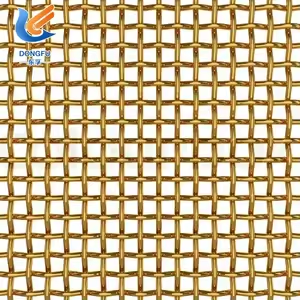
In the vast landscape of industrial materials, few offer the unique combination of strength, versatility, and functionality found in wire mesh material. As a fundamental component across countless sectors, wire mesh is engineered from metallic wires, typically steel, stainless steel, aluminum, or copper alloys, which are woven, welded, or expanded into precise, grid-like structures. This engineered wire mesh material provides an optimal balance of open area and structural integrity, making it indispensable for filtration, separation, reinforcement, protection, and architectural design. For B2B buyers and engineers sourcing reliable components, understanding the specifications, applications, and sourcing options for high-quality wire mesh is critical for project success, operational efficiency, and cost management.
Our premium wire mesh material represents the pinnacle of metallurgical engineering and precision manufacturing. We produce a comprehensive range of mesh types, including woven wire mesh, welded wire mesh, and expanded metal mesh, each tailored to meet specific industrial demands. The core value of our product lies in its adaptability; by varying the wire diameter, mesh opening (aperture), weave pattern, and alloy composition, we can engineer a solution for virtually any technical requirement. From ultra-fine filtration meshes measured in microns to heavy-duty grating used in construction, our inventory and custom fabrication capabilities ensure you receive a wire mesh material that performs reliably under pressure, temperature, and corrosive conditions. We serve as a strategic partner to global industries, providing not just a product, but a engineered material solution.
The performance of a wire mesh material is defined by its technical parameters. The table below outlines the standard specifications for our core product lines. Custom specifications outside these ranges are available upon request for specialized projects.
| Parameter | Woven Wire Mesh | Welded Wire Mesh | Expanded Metal Mesh | Material Grades |
|---|---|---|---|---|
| Primary Material | Stainless Steel 304/316, Low-Carbon Steel, Brass, Aluminum | Low-Carbon Steel (Galvanized), Stainless Steel 304 | Low-Carbon Steel, Aluminum, Stainless Steel 304 | AISI 304, 316, 430, MS1018, etc. |
| Mesh Opening (Aperture) | 0.025 mm to 25 mm | 6 mm to 100 mm | 1 mm to 50 mm (Short Way of Diamond) | Custom apertures available |
| Wire Diameter / Strand Thickness | 0.025 mm to 5.0 mm | 0.8 mm to 6.0 mm | 0.5 mm to 6.0 mm (Sheet Thickness) | Varies by mesh type |
| Weave / Pattern | Plain Weave, Twill Weave, Dutch Weave | Square Grid, Rectangular Grid | Standard Diamond, Flattened | Affects strength & filtration |
| Standard Sheet Size | 1m x 30m (Rolls), 1m x 2m (Sheets) | 1.2m x 2.4m, 1m x 2m | 1m x 2m, 1.2m x 2.4m | Custom cutting to size |
| Surface Treatment | Electropolished, Black Oxide | Hot-Dipped Galvanized, PVC Coated, Powder Coated | Galvanized, Painted, Mill Finish | For corrosion protection & aesthetics |
The utility of a well-specified wire mesh material spans the entire spectrum of industrial and commercial activity. Its primary function dictates its form, but its applications are nearly limitless.
In industries such as oil & gas, chemical processing, pharmaceuticals, and food & beverage, our precision woven meshes act as critical filter media. They separate solids from liquids and gases, classify particles by size in screening operations, and function as catalyst support beds in reactors. The exacting tolerances of our wire mesh material ensure consistent particle retention and process purity.
Architects and designers leverage the aesthetic and functional qualities of wire mesh for building facades, sunscreens, interior balustrades, and ceiling systems. It provides shading, ventilation, and a modern aesthetic while maintaining durability. Our range of finishes allows the wire mesh material to blend with or stand out in any design language.
Welded and heavy-duty woven meshes are fabricated into machine guards, safety barriers, window and door screens, and perimeter fencing. This application relies on the high tensile strength and impact resistance of the wire mesh material to protect personnel, equipment, and property without completely obstructing visibility or airflow.
In construction and civil engineering, welded wire mesh (WWM) and expanded metal are embedded in concrete for crack control and tensile reinforcement (e.g., in slabs and pavements). In mining and agriculture, mesh is used for rock fencing, gabions, soil stabilization, and animal enclosures, where its structural integrity under load is paramount.
Selecting a supplier for a critical component like wire mesh material is a strategic decision. We distinguish ourselves through a commitment to partnership that extends far beyond a simple transaction.
We operate with a solution-oriented mindset. Our process begins with a deep understanding of your application's operational environment, performance requirements, and budget constraints. This allows us to recommend not just a product, but an optimized material solution. Our manufacturing facilities are equipped with advanced technology capable of handling both large-volume standard orders and complex, low-volume custom fabrications with equal precision.
Our dedication to consistent quality is embedded in our production protocol. From raw material certification to final packaging, traceability and consistency are guaranteed. Furthermore, we understand the pressures of international trade. Our dedicated export department manages all documentation, certifications, and logistics, ensuring a smooth, hassle-free supply chain from our factory floor to your receiving dock. When you partner with us, you gain more than a supplier; you gain a reliable extension of your procurement and engineering team, dedicated to ensuring the wire mesh material you receive contributes directly to the success and reliability of your end product.
A: The key difference lies in the manufacturing process and resulting structure. Woven mesh is created by interlocking wires in an over-and-under pattern, offering high flexibility and a wide range of very fine to coarse openings, ideal for filtration and screening. Welded mesh is made by welding wires at their intersections, creating a rigid, strong grid perfect for structural applications like concrete reinforcement and fencing. Expanded metal mesh is produced from a single metal sheet that is slit and stretched, forming a seamless, durable pattern with high strength-to-weight ratio, often used for walkways, grilles, and fencing.
A: Material selection is primarily driven by the operating environment. Stainless Steel 304 is an excellent, cost-effective general-purpose alloy with good corrosion resistance suitable for most industrial and architectural applications. Choose Stainless Steel 316 when the wire mesh material will be exposed to harsh chemicals, saline environments (coastal or marine applications), or high chloride content, as it contains molybdenum for enhanced pitting and crevice corrosion resistance. For high-temperature applications, consider alloys like 310S. Our technical team can advise based on your specific exposure conditions.
A: Absolutely. Customization is a core part of our service. We regularly produce wire mesh material with non-standard wire diameters, unique aperture sizes, special weave patterns (like twill Dutch weave for high-pressure filtration), and custom panel sizes. We can also apply proprietary coatings or perform specialized fabrication like curving or boxing. Simply provide your drawings or specifications for a prompt quotation.
A: We are committed to international quality standards. Our manufacturing is ISO 9001 certified, and our materials are sourced with full Mill Test Certificates (MTCs) verifying composition and properties. We can supply mesh that complies with ASTM, EN, DIN, and other relevant industry-specific standards upon request. Certifications for specific sectors, such as food grade or construction material approvals, can be discussed for your project.
A: We use robust, weather-resistant packaging to prevent damage during transit. Mesh rolls are typically wrapped in waterproof paper and plastic, then mounted on wooden pallets. Sheets are packed in wooden crates. We handle all aspects of international shipping, including FOB, CIF, or DDP terms as required. Our logistics experts will determine the most efficient and cost-effective method (sea freight for large volumes, air freight for urgent orders) and manage all documentation.
PREV:wire mesh cage
Understanding 100 mesh stainless steel screen for Industrial Applications

Detailed Analysis of 2mm Stainless Steel Mesh Properties and Applications

Understanding 1mm Stainless Steel Wire Mesh for Filtration and Industrial Applications
Strategic Custom Metal Fabrication Services

Detailed Analysis of 24 mesh stainless steel screen Applications and Performance
Ready to move your project from technical blueprint to precision reality? Whether you require large-scale CNC machining, complex structural assembly, or specialized fabrication with rare alloys like Titanium and Nickel, our engineering team is prepared to assist. At metalfabricationcn.com, we solve the manufacturing challenges that others find too large or too complex. Reach out today to discuss your specific requirements, and let us help you optimize your supply chain with ISO 9001 certified reliability.