
Detailed Analysis of 24 mesh stainless steel screen Applications and Performance

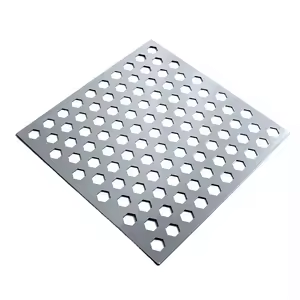
In the world of industrial manufacturing, construction, and filtration, selecting the correct mesh wire sizes is a fundamental decision that directly impacts the performance, durability, and cost-effectiveness of your project. Mesh wire, a versatile material fabricated from interlocking wires, is defined by its mesh count and wire diameter, parameters that determine its strength, openness, and application suitability. This product page serves as your definitive resource for understanding the critical specifications and sourcing high-quality mesh wire tailored to your precise industrial requirements. Whether for heavy-duty screening, precise filtration, architectural facades, or security fencing, mastering mesh wire sizes is the first step toward optimal project outcomes.
Our industrial mesh wire is engineered to meet the rigorous demands of global trade and application-specific challenges. We supply a comprehensive range of mesh wire sizes, manufactured from high-grade materials including stainless steel, galvanized steel, aluminum, and brass. The product is characterized by its uniform weave, consistent aperture size, and exceptional structural integrity. The term "mesh size" specifically refers to the number of openings per linear inch, while the wire diameter dictates the mesh's strength and percentage of open area. Understanding the relationship between these two factors is crucial. For instance, a fine mesh with a high count and thin wire is ideal for precision filtration, whereas a larger mesh with a thick wire is suited for robust screening or fencing. We provide expert guidance to help you navigate this specification landscape, ensuring you procure the exact mesh wire sizes that align with your technical and budgetary parameters.
Our product range covers a vast spectrum of mesh wire sizes to cater to diverse industrial needs. The table below outlines standard specifications for our popular welded wire mesh series. Custom sizes, wire gauges, and sheet dimensions are available upon request.
| Mesh Size (Openings per Inch) | Wire Diameter (mm) | Wire Diameter (SWG) | Approx. Open Area (%) | Common Material Grades | Typical Roll/Sheet Width |
|---|---|---|---|---|---|
| 1/2" x 1/2" | 2.00 mm - 3.50 mm | 12 - 8 | ~65% - 75% | Galvanized Steel, Stainless Steel | 1m, 1.2m, 1.5m, 2m |
| 1" x 1" | 1.60 mm - 2.50 mm | 16 - 12 | ~70% - 80% | Galvanized Steel, PVC Coated | 1m, 1.2m, 1.5m, 2m |
| 2" x 2" | 1.20 mm - 2.00 mm | 18 - 14 | ~75% - 85% | Galvanized Steel, Aluminum | 1m, 1.2m, 1.5m |
| 4" x 4" | 1.00 mm - 1.60 mm | 19 - 16 | ~80% - 90% | Galvanized Steel, Stainless Steel | 1m, 1.2m |
| 10 Mesh | 0.50 mm - 0.80 mm | 24 - 20 | ~50% - 60% | Stainless Steel 304, Brass | 1m, 1.2m (Sheets) |
| 30 Mesh | 0.25 mm - 0.35 mm | 30 - 28 | ~35% - 45% | Stainless Steel 316 | 1m (Sheets) |
| 60 Mesh | 0.15 mm - 0.20 mm | 34 - 32 | ~30% - 40% | Stainless Steel 316 | 1m (Sheets) |
| 100 Mesh | 0.10 mm - 0.15 mm | 38 - 34 | ~25% - 35% | Stainless Steel 316 | 1m (Sheets) |
Note: SWG = Standard Wire Gauge. All specifications are nominal and subject to standard manufacturing tolerances. Open area is approximate and varies with exact wire diameter.
The correct selection of mesh wire sizes enables this material to perform critical functions across industries:
Choosing our mesh wire products delivers tangible benefits to your operations:
In a competitive global market, we distinguish ourselves as a partner you can rely on for critical industrial components.
A: To specify mesh wire, you typically need three key parameters: 1) Mesh Count (e.g., 10x10, meaning 10 openings per inch in both directions), 2) Wire Diameter (in mm, inches, or SWG), and 3) Material & Finish. Providing the intended application and any environmental factors (chemical exposure, temperature, load) allows us to make the best recommendation.
A: Mesh count (e.g., 40 mesh) refers to the number of openings per linear inch. Aperture size is the actual measurement of the clear opening between wires. Two meshes with the same count can have different aperture sizes if the wire diameter differs. We always recommend confirming both the mesh count and wire gauge when discussing mesh wire sizes.
A: Absolutely. While we stock a wide range of standard imperial and metric mesh wire sizes, a significant part of our business is custom manufacturing. We can produce mesh with specific aperture dimensions (e.g., 3mm x 6mm rectangular openings) and custom wire diameters to meet unique engineering specifications.
A: Material is critical. For example, a 20 mesh in stainless steel 316L offers excellent corrosion resistance for chemical filtration, while the same mesh wire size in galvanized steel would be a cost-effective choice for general industrial screening but would corrode in a saline environment. The mesh size controls the filtration grade, while the material ensures longevity under operational conditions.
A: Standard mesh rolls are typically packed on sturdy wooden spools and palletized, while sheets are crated for maximum protection during ocean freight. Lead times vary based on order volume and customization. Standard size orders can often be shipped within 7-14 days, while large custom orders may require 3-4 weeks. We provide a firm timeline with every quotation.
PREV:gauge of wire mesh
NEXT:modelling wire mesh
Detailed Analysis of 24 mesh stainless steel screen Applications and Performance
Strategic Custom Metal Fabrication Services

Detailed Analysis of 2mm Stainless Steel Mesh Properties and Applications

Understanding 30 Mesh Stainless Steel Screen Applications and Material Properties
Comprehensive Guide to Durable 316 Stainless Steel Security Screens
Ready to move your project from technical blueprint to precision reality? Whether you require large-scale CNC machining, complex structural assembly, or specialized fabrication with rare alloys like Titanium and Nickel, our engineering team is prepared to assist. At metalfabricationcn.com, we solve the manufacturing challenges that others find too large or too complex. Reach out today to discuss your specific requirements, and let us help you optimize your supply chain with ISO 9001 certified reliability.