
Understanding 20 mesh stainless steel screen Applications and Performance

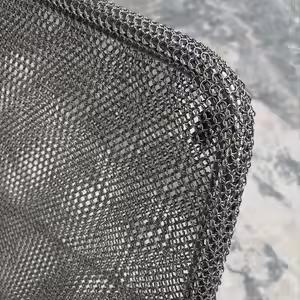
In the world of modern construction, structural integrity is non-negotiable. At the heart of countless durable concrete structures lies a critical component: welded wire mesh for concrete. This high-strength reinforcement material is manufactured from high-quality steel wires, precision-welded at every intersection to form a rigid grid. Designed to be embedded within concrete slabs, walls, and pavements, it effectively distributes tensile stresses, controls cracking, and significantly enhances the load-bearing capacity and longevity of the finished structure. For contractors, engineers, and procurement managers sourcing reliable building materials, understanding the specifications and applications of premium welded wire mesh for concrete is a fundamental step toward ensuring project success, safety, and compliance with international building codes.
Our welded wire mesh is engineered to meet the rigorous demands of professional construction and industrial applications. It is more than just a grid; it's a systematically designed reinforcement solution.
Selecting the correct specification is crucial for structural performance. Below is a detailed table outlining our standard range of welded wire mesh for concrete reinforcement. Custom sizes and configurations are available upon request for large-scale or specialized projects.
| Mesh Designation | Longitudinal Wire Spacing (mm) | Transverse Wire Spacing (mm) | Wire Diameter (mm) | Sheet Dimensions (m) | Primary Application |
|---|---|---|---|---|---|
| A142 | 200 | 200 | 6.0 | 2.4 x 4.8 / 2.4 x 6.0 | Light-duty domestic slabs, paths |
| A193 | 200 | 200 | 7.0 | 2.4 x 4.8 / 2.4 x 6.0 | Residential floor slabs, driveways |
| A252 | 200 | 200 | 8.0 | 2.4 x 4.8 / 2.4 x 6.0 | Heavy-duty domestic & commercial floors |
| A393 | 200 | 200 | 10.0 | 2.4 x 4.8 / 2.4 x 6.0 | Industrial floors, heavy load areas |
| D49 | 100 | 200 | 5.0 | 2.4 x 4.8 / Rolls (various widths) | Pavements, thin slabs, crack control |
| D98 | 100 | 200 | 7.0 | 2.4 x 4.8 / Rolls (various widths) | Heavier pavements, structural walls |
Note: All mesh conforms to relevant international standards including ASTM A1064, BS 4483, and AS/NZS 4671. Specifications for yield strength, tensile strength, and bend tests are available in our comprehensive technical datasheets.
The versatility of welded wire mesh for concrete makes it indispensable across a broad spectrum of construction projects. Its primary function is to act as secondary reinforcement, managing thermal and shrinkage stresses to prevent uncontrolled cracking.
Choosing the right reinforcement strategy impacts cost, schedule, and performance. Welded wire mesh for concrete offers a compelling set of advantages.
In the global B2B marketplace for construction materials, partnership and reliability are key. We distinguish ourselves not just as a supplier, but as a technical partner committed to your project's success.
Rebar is typically used as primary, structural reinforcement designed to carry specific tensile and compressive loads. Welded wire mesh for concrete is primarily used as secondary, temperature/shrinkage reinforcement to control cracking. In many slab-on-ground applications, WWM is sufficient on its own. For structural elements, they are often used together, with rebar for main strength and mesh for crack control.
The specification (e.g., A193, A252) is determined by structural engineers based on the design loads, slab thickness, subgrade conditions, and local building codes. Always refer to the project's engineering drawings. As a general rule, heavier loads and thinner slabs require a heavier mesh designation (larger wire diameter).
For slabs-on-ground subject to uniform loading, welded wire mesh for concrete is typically placed in the upper third of the slab to resist the tensile stresses that cause shrinkage cracks at the surface. For structural slabs, placement is dictated by the engineering design to resist specific bending moments (often near the bottom for simply supported spans). Proper positioning using chairs or bolsters is critical.
Yes. We supply both standard (bright) and galvanized welded wire mesh for concrete. Hot-dip galvanized mesh is recommended for projects in corrosive environments, such as marine climates, wastewater treatment plants, or parking structures exposed to de-icing salts, to ensure long-term durability.
Mesh is typically bundled securely with steel strapping on wooden pallets for sheets, or in compact rolls. Standard specifications are often available from stock for prompt shipment. For large custom orders, lead times are communicated transparently upon order confirmation. We prioritize efficient production scheduling to align with your construction timeline.
PREV:6x6 10 wire mesh
NEXT:wire mesh tape
Understanding 20 mesh stainless steel screen Applications and Performance
Understanding 16 Mesh Stainless Steel Screen Applications and Performance

Understanding 100 mesh stainless steel screen for Industrial Applications
Strategic Custom Metal Fabrication Services

Detailed Analysis of 2mm Stainless Steel Mesh Properties and Applications
Ready to move your project from technical blueprint to precision reality? Whether you require large-scale CNC machining, complex structural assembly, or specialized fabrication with rare alloys like Titanium and Nickel, our engineering team is prepared to assist. At metalfabricationcn.com, we solve the manufacturing challenges that others find too large or too complex. Reach out today to discuss your specific requirements, and let us help you optimize your supply chain with ISO 9001 certified reliability.