
Understanding 30 Mesh Stainless Steel Screen Applications and Material Properties

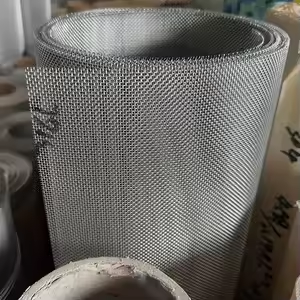
In the demanding world of industrial manufacturing, construction, and filtration, precision is non-negotiable. The accurate measurement of mesh opening and wire diameter is fundamental to ensuring product quality, process efficiency, and compliance with international standards. This is where the wire mesh gauge becomes an indispensable instrument. More than just a measuring tool, a professional-grade wire mesh gauge is a quality assurance device that provides immediate, reliable verification of mesh count, wire thickness, and aperture size. Designed for engineers, quality control inspectors, and procurement specialists, our gauges offer unmatched accuracy and durability for a wide range of industrial applications, from heavy-duty mining screens to fine pharmaceutical filters.
Our professional wire mesh gauge is engineered to deliver fast, accurate, and repeatable measurements of woven wire cloth and welded mesh. It eliminates the guesswork and potential errors associated with manual calipers or visual estimation. The tool typically combines two primary functions: a series of precision-notched slots for determining wire diameter (SWG or metric) and a lens or graduated scale for counting the number of openings per linear inch or centimeter (mesh count). By providing a direct physical reference, it allows users to quickly verify that incoming materials or production samples conform to specified wire mesh gauge standards, such as ASTM E11, ISO 9044, or custom specifications. This immediate feedback is crucial for maintaining supply chain integrity and preventing costly production delays caused by out-of-spec materials.
| Model Series | Measurement Range (Mesh Count) | Wire Diameter Range | Material | Standards | Dimensions (approx.) |
|---|---|---|---|---|---|
| WMG-100 (Standard) | 2 - 100 per inch / 1 - 40 per cm | 0.010" - 0.250" / 0.25mm - 6.35mm | Hardened Stainless Steel | ASTM E11, Market Grade | 120mm x 65mm x 5mm |
| WMG-200 (Fine Mesh) | 30 - 200 per inch / 12 - 80 per cm | 0.001" - 0.050" / 0.025mm - 1.27mm | Anodized Aluminum & Optical Glass | ASTM E11, Mill Grade | 100mm x 50mm x 8mm (with lens) |
| WMG-400 (Ultra-Fine) | 150 - 400 per inch / 60 - 160 per cm | 0.0006" - 0.015" / 0.015mm - 0.38mm | Precision Aluminum Alloy | ISO 9044, Micron Ratings | 90mm x 45mm x 10mm (high-power lens) |
| WMG-C (Combo Set) | 2 - 400+ (across 3 gauges) | Full range coverage | Stainless Steel & Aluminum Set | Multi-Standard (ASTM, ISO, TYLER) | Set in protective case |
Note: All gauges are supplied with a calibration certificate traceable to national standards. Custom ranges and dual-unit markings (Imperial/Metric) are available upon request.
The versatility of a precise wire mesh gauge makes it a critical tool across numerous sectors. In mining and aggregate processing, it is used to verify the opening size of vibrating screens and crusher meshes, directly impacting material grading and operational throughput. Within the chemical and pharmaceutical industries, the gauge ensures filtration meshes and sieve cloth meet strict purity and particle size distribution requirements for catalysts, active ingredients, and final products. Food and beverage manufacturers rely on it to check sieves and strainers for consistency in product texture and safety. In construction and architecture, it confirms the specifications of reinforcing mesh and decorative wire cladding. Furthermore, quality control labs and procurement departments across all these industries use the wire mesh gauge for incoming inspection, preventing non-conforming materials from entering the production cycle and safeguarding against supplier discrepancies.
Selecting the right measurement tool is an investment in your company's quality infrastructure. Our wire mesh gauges are not commodity items; they are precision instruments crafted for industrial professionals. We specialize in serving the international B2B market, understanding the critical need for tools that perform reliably day after day. Our products are the result of direct collaboration with industry users, ensuring every feature addresses a real-world need. We back our gauges with full technical support and customization options, allowing you to specify the exact measurement ranges and standards your operations require. Furthermore, our commitment to durable materials and precision manufacturing means your wire mesh gauge will remain a trusted part of your QC toolkit for years, providing an exceptional return on investment through safeguarded quality and efficiency.
A: Align the magnifying lens or the edge of the gauge with the mesh. Count the number of openings in one linear inch (or centimeter) along the scale. The point where the mesh pattern aligns perfectly with the scale indicates the mesh count. For accuracy, take several readings across the sample.
A: While our Combo Set (WMG-C) offers the broadest range, a single gauge typically covers a specific spectrum. For operations dealing with vastly different meshes (e.g., coarse quarry screens and fine filter cloth), we recommend multiple gauges or a custom set to ensure accuracy across all materials.
A: Our professional-grade gauges provide exceptional accuracy suitable for 99% of industrial QC applications. They are calibrated to provide reliable pass/fail verification against specifications. For absolute micron-level analysis or official certification, lab equipment is required, but for rapid in-process and incoming inspection, our wire mesh gauge is the optimal tool.
A: This is a common challenge in international trade. Our gauges often include dual markings. You can use the wire diameter notch to verify the wire size, and the mesh count to verify openings per inch. With these two values, you can calculate the approximate aperture. We also offer custom gauges marked with specific aperture sizes to match your exact drawings.
A: Standard custom orders (e.g., adding a company logo, specific grade markings) typically have a lead time of 2-3 weeks. For entirely new ranges or complex specifications, our engineering team will provide a specific timeline upon review of your requirements.
A: Yes. We recommend annual calibration for gauges used in critical quality control processes. We offer a recalibration service, returning your instrument with a new certificate of conformity. Please contact our support team to arrange this service.
Understanding 30 Mesh Stainless Steel Screen Applications and Material Properties

Understanding 304 Stainless Steel Mesh Screen for Industrial Applications

Comprehensive Guide to Durable 316 Stainless Steel Security Screens

Understanding the Versatility of 10 mesh stainless steel screen Applications
Detailed Analysis of 2mm Stainless Steel Mesh Properties and Applications
Ready to move your project from technical blueprint to precision reality? Whether you require large-scale CNC machining, complex structural assembly, or specialized fabrication with rare alloys like Titanium and Nickel, our engineering team is prepared to assist. At metalfabricationcn.com, we solve the manufacturing challenges that others find too large or too complex. Reach out today to discuss your specific requirements, and let us help you optimize your supply chain with ISO 9001 certified reliability.