
Understanding 300 Mesh Stainless Steel Screen Applications and Performance

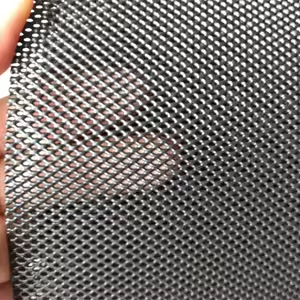
In the demanding world of industrial manufacturing, construction, and filtration, selecting the right material for reinforcement, separation, and protection is critical. Glass wire mesh stands out as a premier engineered material, combining the inherent strength of woven wire with the exceptional properties of a glass coating. This fusion creates a product that is not only incredibly durable and resistant to corrosion but also offers superior thermal stability and fire resistance. Ideal for a vast range of high-temperature and corrosive environments, glass fiber reinforced wire mesh is the go-to choice for industries requiring reliability and longevity. This product page delves into the comprehensive details, specifications, and advantages of our premium glass coated wire mesh, designed to meet and exceed global industrial standards.
Our glass wire mesh is a high-performance composite material manufactured by expertly coating a high-tensile steel or stainless-steel wire mesh with a specially formulated glass enamel. This process is performed at extremely high temperatures, resulting in a permanent, vitreous bond between the glass and the metal substrate. The outcome is a mesh that retains the flexible strength and structural integrity of wire while gaining the chemical inertness, heat resistance, and smooth surface finish of glass. This product is engineered to solve persistent challenges in sectors like petrochemical processing, power generation, aerospace, and architectural cladding, where exposure to heat, chemicals, and stress would rapidly degrade ordinary materials. Available in various mesh counts, wire diameters, and roll dimensions, our glass fiber mesh can be customized to fit precise application requirements, ensuring optimal performance and value.
The following table outlines the standard specifications for our industrial-grade glass coated wire mesh. Custom configurations regarding mesh size, wire gauge, width, and coating color are available upon request for bulk orders.
| Parameter | Specification / Value | Remarks |
|---|---|---|
| Base Material | High-Carbon Steel / AISI 304 / AISI 316 Stainless Steel | Selection depends on required strength & corrosion resistance. |
| Coating Material | Vitreous Glass Enamel | Fused to the wire at high temperature for a permanent bond. |
| Mesh Count (per inch/cm) | 2 x 2 to 20 x 20 (Standard) Custom weaves available |
Determines openness and particle retention size. |
| Wire Diameter | 0.5 mm to 2.5 mm | Directly influences mesh strength and weight. |
| Roll Width | 1.0 m, 1.2 m, 1.5 m (Standard) Up to 2.0 m (Custom) |
Standard widths for ease of handling and installation. |
| Roll Length | 30 m (Standard) Custom lengths available |
Minimizes joins and waste on large projects. |
| Continuous Service Temperature | Up to 550°C (1022°F) | Ideal for high-heat applications without loss of integrity. |
| Color | Standard: Black, White, Green Custom RAL colors available |
Color can be specified for coding or aesthetic purposes. |
The unique properties of glass wire mesh make it indispensable across a diverse range of industrial and commercial sectors.
Used as filter media in catalyst recovery, gas filtration in power plants, and liquid/solid separation in chemical processing. The smooth surface prevents blinding and allows for efficient backwashing.
Serves as a reinforcing core for high-temperature insulation blankets, gaskets for flanges and exhaust systems, and as a containment mesh for refractory linings in furnaces and kilns.
Employed as a durable, ventilated, and aesthetically flexible cladding material for modern buildings. Its fire resistance makes it a safe choice for decorative sunscreens and interior design elements.
Fabricated into spark arrestors for flammable environments, protective screens for machinery and lighting, and fireproof curtains in industrial settings.
Used to reinforce plastic, rubber, and cement-based composites, providing enhanced crack resistance and structural stability in demanding environments.
Choosing our glass fiber reinforced wire mesh provides distinct competitive benefits compared to standard galvanized, PVC-coated, or plain stainless-steel meshes.
This combination of benefits ensures that glass wire mesh delivers unparalleled performance, safety, and cost-efficiency over the long term.
As a leading supplier in the international industrial marketplace, we are committed to delivering more than just a product; we provide a reliable, value-driven partnership.
A: They are fundamentally different materials. Glass wire mesh has a metal (steel/stainless steel) wire core coated with glass enamel. Fiberglass mesh is woven entirely from glass fibers. Our product offers much higher strength and structural rigidity due to its metal core, while fiberglass mesh is generally lighter and more flexible but less durable under mechanical stress.
A: Yes, it can be cut with appropriate tools (e.g., heavy-duty snips, abrasive wheels) and formed to a certain degree. However, excessive bending or forming on a small radius may cause the glass coating to crack. For complex shapes, we recommend consulting our technical team for advice or exploring pre-fabricated components.
A: Both offer excellent chemical resistance, but in different domains. Glass wire mesh excels in resistance to strong acids, alkalis, and high temperatures where Teflon (PTFE) might degrade. Teflon has superior resistance to certain solvents and offers a lower coefficient of friction. The choice depends on the specific chemical environment and temperature of your application.
A: Absolutely. The glass coating is highly resistant to UV radiation, moisture, and temperature cycling, making it an excellent, low-maintenance material for building facades, sunscreens, and balcony enclosures. Its color stability and resistance to fading ensure long-term aesthetic appeal.
A: Lead times vary based on the complexity and quantity of the order. Standard specifications are typically available for shipment within 7-14 days. For custom weaves, special sizes, or large-volume projects, our standard lead time is 4-6 weeks. We provide precise timelines upon receipt of your detailed inquiry and work diligently to meet critical project deadlines.
For further technical data sheets, samples, or a detailed quotation tailored to your specific project requirements, please contact our sales department. Let us provide you with the robust, high-performance glass wire mesh solution that your application demands.
PREV:cabinet decorative wire mesh
NEXT:wire screen mesh
Understanding 300 Mesh Stainless Steel Screen Applications and Performance
Understanding 20 mesh stainless steel screen Applications and Performance

Comprehensive Guide to Durable 316 Stainless Steel Security Screens

Understanding 1mm Stainless Steel Wire Mesh for Filtration and Industrial Applications
Understanding 16 Mesh Stainless Steel Screen Applications and Performance
Ready to move your project from technical blueprint to precision reality? Whether you require large-scale CNC machining, complex structural assembly, or specialized fabrication with rare alloys like Titanium and Nickel, our engineering team is prepared to assist. At metalfabricationcn.com, we solve the manufacturing challenges that others find too large or too complex. Reach out today to discuss your specific requirements, and let us help you optimize your supply chain with ISO 9001 certified reliability.