
Detailed Analysis of 2mm Stainless Steel Mesh Properties and Applications

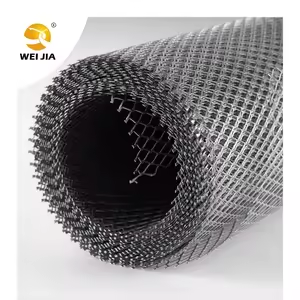
In the world of industrial materials, precision is paramount. Selecting the correct wire mesh size is not merely a matter of specification; it is a critical engineering decision that directly impacts the efficiency, safety, and cost-effectiveness of your operations. Our comprehensive range of industrial wire mesh is engineered to meet the most demanding international standards, offering unparalleled consistency and performance across a vast spectrum of wire mesh sizes and configurations. This product page serves as your ultimate resource for understanding, selecting, and sourcing the ideal mesh for your application.
Industrial wire mesh, a versatile material fabricated from interlocking wires, is defined by its precise wire mesh size. This term encompasses two fundamental dimensions: the mesh count (number of openings per linear inch or centimeter) and the wire diameter. The relationship between these two factors determines the mesh's open area, strength, weight, and flow characteristics. Our product line is meticulously manufactured, covering everything from ultra-fine micron-grade filtration meshes to heavy-duty screening and architectural meshes. We understand that the correct wire mesh size is the cornerstone of successful application performance, whether for precise particle separation, robust structural reinforcement, or secure perimeter fencing. Our global supply chain and stringent quality control ensure you receive a product that performs exactly as specified, every time.
The table below outlines standard specifications for our most common wire mesh products. Custom wire mesh sizes, materials, and weaves are available upon request to meet your unique project requirements.
| Mesh (# per inch) | Wire Diameter (mm) | Opening Size (mm) | Open Area (%) | Common Material | Primary Weave | Typical Application |
|---|---|---|---|---|---|---|
| 2 x 2 | 2.00 | 10.70 | 71 | Galvanized Steel | Plain / Welded | Heavy Screening, Fencing |
| 10 x 10 | 0.71 | 1.83 | 51 | Stainless Steel 304 | Plain Weave | Industrial Guards, Sorting |
| 30 x 30 | 0.315 | 0.532 | 40 | Stainless Steel 316 | Plain Weave | Fine Filtration, Sieving |
| 100 x 100 | 0.10 | 0.154 | 36 | Stainless Steel 316L | Plain / Twill Weave | Precision Laboratory Filtration |
| 200 x 200 | 0.05 | 0.077 | 35 | Stainless Steel 316L | Twill Dutch Weave | Micron-Level Filtration, Pulp & Paper |
| Custom | 0.025 - 6.0 | 0.02 - 100+ | 10 - 85 | Various Alloys | All Standard & Custom | Specialized Industrial Use |
Note: Specifications are nominal and may vary slightly based on material and weave. Metric and imperial wire mesh sizes are available. Detailed data sheets are provided with all quotations.
The correct wire mesh size enables functionality across a staggering array of industries. Our products are integral components in global supply chains.
From filtering chemicals and pharmaceuticals to separating aggregates in mining, the precise wire mesh size ensures accurate particle retention. Fine meshes (e.g., 200x200) are used in fuel and hydraulic systems, while coarser meshes protect pumps and valves from debris.
In food processing, agriculture, and aggregate industries, vibrating screens with specific wire mesh sizes classify materials by grain or particle size, ensuring product consistency and quality control.
Wire mesh serves as innovative facades, sunscreens, balustrades, and interior design elements. The aesthetic appeal of different wire mesh sizes and weaves is matched by their functional benefits in ventilation, light diffusion, and security.
Heavy-duty welded meshes with large wire diameters provide robust, tamper-resistant solutions for perimeter security, machine guarding, animal enclosures, and storage cages.
In construction, wire mesh reinforces concrete (e.g., in slabs and pavements), stabilizes embankments, and provides support for plaster and stucco. The wire mesh size and gauge are selected based on structural load requirements.
Selecting a supplier for a critical component like wire mesh requires trust and proven capability. We distinguish ourselves as the partner of choice for global industrial buyers.
Unmatched Technical Expertise: Our team comprises engineers and material specialists who provide more than just a product—they offer application-specific consulting. We help you analyze your needs to specify the perfect wire mesh size, material, and configuration, preventing costly specification errors.
Global Scale, Local Service: We operate a distributed manufacturing and warehousing network, ensuring reliable, timely delivery to major industrial hubs worldwide. You benefit from global pricing advantages coupled with responsive, localized customer support.
Rigorous Quality Assurance: Every batch of material is traceable, and our production processes are continuously monitored. We provide Mill Test Certificates (MTCs) and material certifications as standard, giving you complete confidence in the product's provenance and properties.
Commitment to Innovation: We invest in advanced weaving technology and metallurgical research to continually expand our range of wire mesh sizes and capabilities, offering solutions for emerging industrial challenges.
Strategic Partnership Approach: We view our clients as long-term partners. Our flexible ordering, custom fabrication services, and dedicated account management are designed to integrate seamlessly with your operations and supply chain.
A: Determining the optimal wire mesh size requires considering several factors: the size of particles you need to retain or allow to pass, the required flow rate or throughput, the mechanical load or pressure the mesh will endure, and the environmental conditions (chemical exposure, temperature). We strongly recommend consulting with our technical team. Providing details such as sample particles, operating parameters, and industry standards will allow us to recommend the most effective specification.
A: These are the two core components of a wire mesh size. Mesh count refers to the number of openings per linear inch (or centimeter). A 100-mesh screen has 100 openings per inch. Opening size is the precise distance between two adjacent wires, usually measured in millimeters or microns. A higher mesh count generally means a smaller opening size, but the wire diameter also affects this. A detailed specification always includes both mesh count and wire diameter.
A: Absolutely. While we stock a comprehensive range of standard wire mesh sizes in roll and sheet form, a significant portion of our business is dedicated to custom fabrication. We can precision-cut blanks, fabricate cylindrical filter elements, create tensioned screen panels with reinforced edges, and form complex shapes to your exact drawings. Send us your CAD files or sketches for a prompt quotation.
A: The material is as critical as the wire mesh size. For example, a 20x20 mesh in standard carbon steel may be suitable for a indoor sorting application, but the same mesh size in Type 316 Stainless Steel would be necessary for a corrosive chemical environment or a food-grade process. Material affects corrosion resistance, strength, temperature tolerance, magnetism, and cost. Our experts will guide you to the most cost-effective and performance-appropriate material for your conditions.
A: We provide full traceability and quality assurance. Standard documentation with shipment includes a Mill Test Certificate (MTC) or Material Test Report (MTR) verifying the chemical composition and physical properties of the metal. We can also provide certifications of conformity to specific standards like ASTM, ISO, or DIN upon request. Our quality management system is designed to meet the stringent requirements of our global industrial clientele.
PREV:monel wire mesh
NEXT:wire mesh for cement
Detailed Analysis of 2mm Stainless Steel Mesh Properties and Applications

Understanding 304 Stainless Steel Mesh Screen for Industrial Applications

Understanding 16 Mesh Stainless Steel Screen Applications and Performance
Understanding 300 Mesh Stainless Steel Screen Applications and Performance
Strategic Custom Metal Fabrication Services
Ready to move your project from technical blueprint to precision reality? Whether you require large-scale CNC machining, complex structural assembly, or specialized fabrication with rare alloys like Titanium and Nickel, our engineering team is prepared to assist. At metalfabricationcn.com, we solve the manufacturing challenges that others find too large or too complex. Reach out today to discuss your specific requirements, and let us help you optimize your supply chain with ISO 9001 certified reliability.